This Week in EqIQ
A progress letter from Equine Data Systems for investors, partners and friends. In Issue 1, EqIQ became a working product. In the nine days since, farriers moved in, every page got ready to be found, every professional got a face, and the admin room learned to talk to members and partners.
Seven things to know
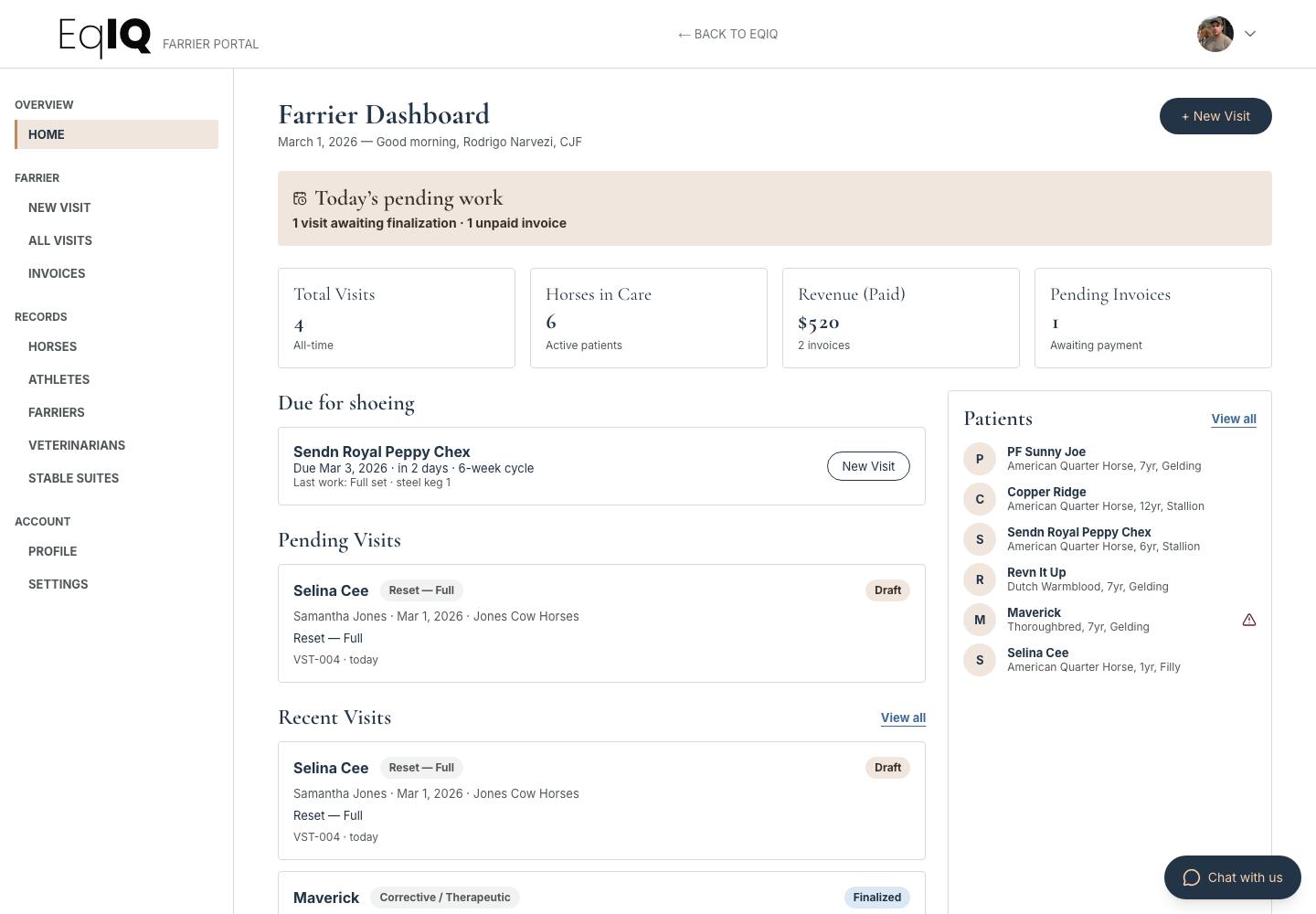
- Farriers have their own workspace. A farrier is the person who trims a horse's hooves and fits its shoes. Now a farrier can write up a visit foot by foot and send the bill, and a signed record lands on the horse's page. It was planned and built in one day.
- EqIQ is ready to be found. Every horse, person and place has a web address you can read, like /horses/sendn-royal-peppy-chex. There are 9,630 pages lined up for Google and AI assistants, including pages like "Equine Veterinarians in Paris, Texas." It all stays switched off until real members arrive.
- Every professional has a face. 2,449 new pictures: a headshot for every listed vet, farrier, trainer and athlete, a photo of every horse hauler's truck and trailer, and photo galleries. They cost $162 to make.
- People decide what the world sees. Every person and every horse can be Public, Semi-private or Private. For a child, only a parent can open the page up.
- EqIQ can talk to members and partners. An admin can write an email and send it to one member or a saved group. A partner company, like an insurer, can get a key to EqIQ's public data, with a speed limit and a log of every request.
- It was checked before launch. All twelve demo walk-throughs now run by themselves on a laptop and a phone. A security review, a speed pass and a full hand check found real problems, and almost all of them are fixed.
- It still costs a fraction of the old way. About 74,000 more lines of code, a few months of work for a team of engineers, for about $500 of AI actually paid and about 5½ hours of Karl's time.
CARFAX for horses
New here? Before you buy a used car, you can check a CARFAX report. It tells you who owned the car, what got fixed, and whether anything bad happened. Horses have nothing like that. A horse can cost as much as a house, and people still buy them based on screenshots, paper files and phone calls.
EqIQ gives every horse a permanent record that follows it for life, no matter who owns it or which vet or farrier it sees. The people who know the truth about a horse sign the facts they add. The owner decides who gets to look. The first version does three jobs:
An ID for every horse
Each horse gets a 12-digit EqueID, like a license plate that never changes. People, places and events get one too. Now each one also has a web address you can read.
A history nobody can quietly edit
Every important fact, such as a vaccination, a new set of shoes or a sale, is written once into a chain. Each entry is locked to the one before it. Change an old entry and the chain breaks in plain sight.
Safe ways to buy, sell and get care
A step-by-step purchase flow and an auction room. A vet's office and, new this issue, a farrier's workspace, where a visit becomes a signed record on the horse's page the moment it is finished.
Plans first, then the build
Every big piece of this issue started as a written plan that Karl ruled on. Most of the research this time lived in those plans. The company's Notion workspace was used for marketing and data lists.
-
September 27
Five support tools compared
A support chat needed a vendor. Intercom came first, then Chatwoot, Crisp, Zendesk and Help Scout. Karl chose Intercom and its program for young companies.
-
September 27
The email plan
Twenty numbered requirements for emails that fill in the reader's own details, for member groups, and for emails an admin writes. Karl answered four open questions the same day.
-
September 27 and 28, in Notion
Where the data lives
A list of where horse, rider and trainer records are kept today, from pedigree databases to riding-instructor directories. The directory of breed registries and associations was updated. A contact list of brand inspectors and microchip advocates was added.
-
September 28, before 8:30 a.m.
Two plans before breakfast
The search plan: 50 requirements for being found by Google, Bing and AI assistants such as ChatGPT, Perplexity, Claude and Gemini. The farrier plan: 17 requirements, built on the spring's research into vet software and farrier apps. On paper, search was 52 to 70 engineer-days and the farrier workspace was three to four weeks for two engineers.
-
September 28 to October 1, in Notion
First ads and a trade-show booth
Draft ad lines for buyers, sellers and vets. The favorite so far: "Your Vet Checks the Horse. EqIQ Checks the History." Also a shopping list and small budget for a 10-by-10-foot booth.
-
October 4
Karl sets the order
A status review on Sunday night. Then Karl's order for the next push: clean up, walk every demo story, check everything before launch, then photos, partner keys and emails. He also set spending limits for the run.
-
October 5
The last of the drawings
The design file shows profiles full of photos, careers, credentials and logos. The demo had placeholders. "Phase 6" filled them in. Karl set price ranges for the sample sales that EqueValue compares against: $50,000 to $75,000 for Western horses and $125,000 to $180,000 for English ones.
-
October 5, evening
Four reports before launch
A security review, a speed report, a report on the 2,449 new photographs, and a full walk-through of all twelve demo stories with 545 screenshots. Each one is filed in the project's records, and their findings were fixed the same night.
Two big pushes with a quiet middle
Teams of AI coding agents did the building, each on its own copy of the code, with a reviewer checking every bundle before it went in. Karl set the order and made the calls. Times are Mountain time.
Right after Issue 1
- 9:52 a.m.: the email plan goes in, seven minutes after Issue 1 was finished.
- Intercom is chosen for the support chat. A new address for announcements, news.eqiq.co, is set up.
- Late evening: emails learn to fill in the reader's own details, and admins can filter members a dozen ways and save the result as a group.
Farriers, in a day
- 7:13 a.m.: Karl asks for a farrier workspace. The search and farrier plans are both in by 8:19.
- By 3:15 p.m. every farrier piece is merged: the data, the server, the screens, the owner's view and a robot test.
- The first live walk-through fails. The hosting network was refusing saves that had already worked. Found and fixed in 40 minutes.
- Also today: person pages and privacy settings, readable web addresses, saved copies of public pages, admins who keep their logins, and the support chat just before midnight.
Ready to be found, before sunrise
- Pages by state and city, horses for sale, events by state, offspring lists, venues, vet practices, stables and associations.
- 3:46 a.m.: the search plan is complete, about 20 hours after it started.
A quiet stretch
- No changes merged. The live demo stayed up and unchanged for testers.
Back at it, late
- Karl reviews where things stand and sets the order for the next push.
- 10:53 p.m.: a critical security patch for the web framework goes in the same night it is flagged.
The biggest day
- 24 bundles of work merged, the most since Issue 1.
- Morning: all twelve demo walk-throughs become robot tests. Writing them found about a dozen bugs, all fixed.
- Afternoon: partner keys, 2,449 new photographs, the security review and the speed pass.
- Evening: the fixes from a full hand check, the rest of Phase 6, admin emails, and sending to a person or a group. The demo was reloaded four times that day to show it all.
All green
- Overnight, the robot tests pass on the newest code and the live demo's health check is green.
- This letter.
A tour of the new work
Real screenshots, taken today from the live demo. The admin screens come from a copy of the same code running with sample data, because the live admin room needs a second sign-in code. Every horse, person, price and ad is sample data. The ad artwork comes from the design file and does not mean those brands are sponsors.
1. The farrier's workspace
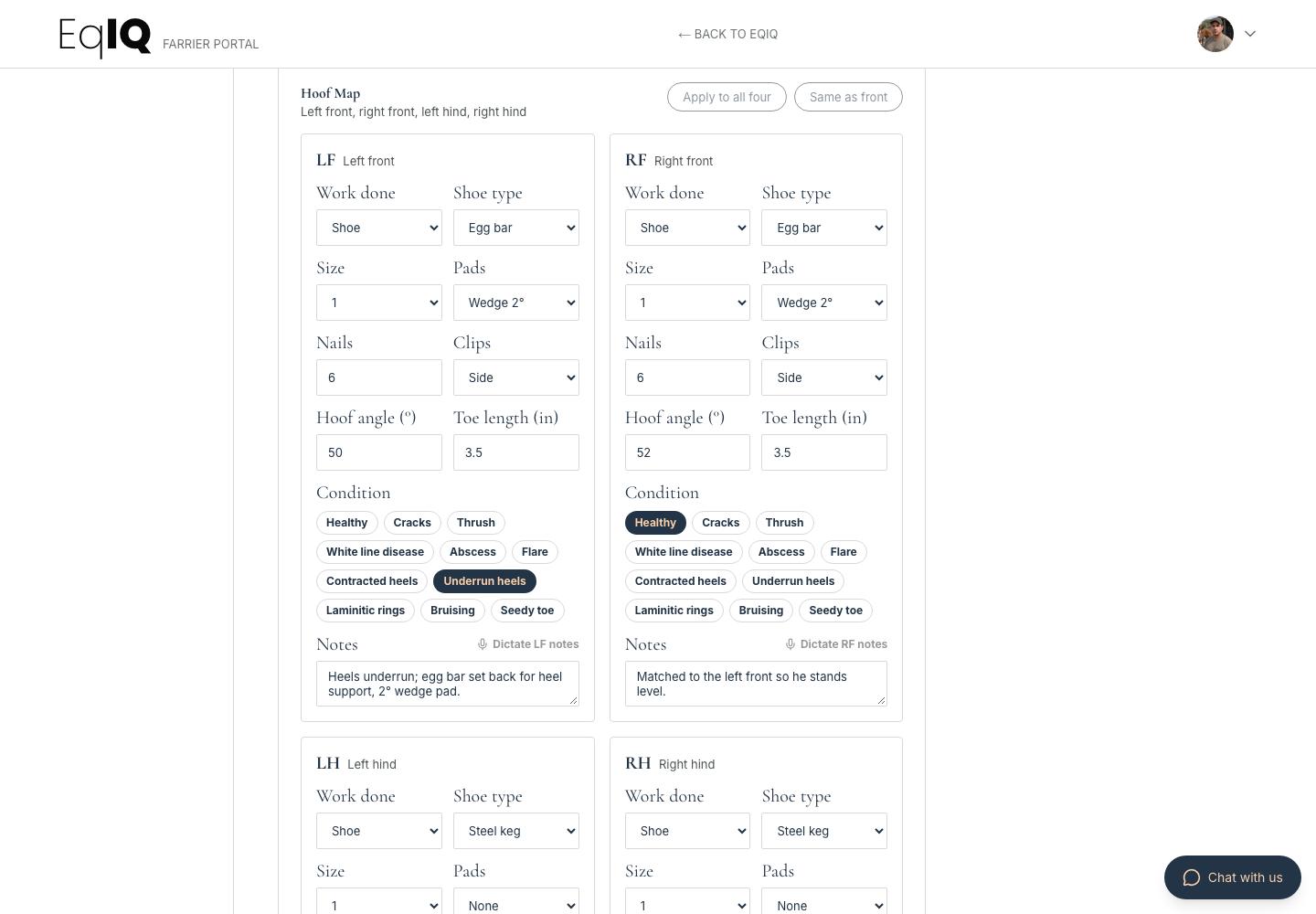
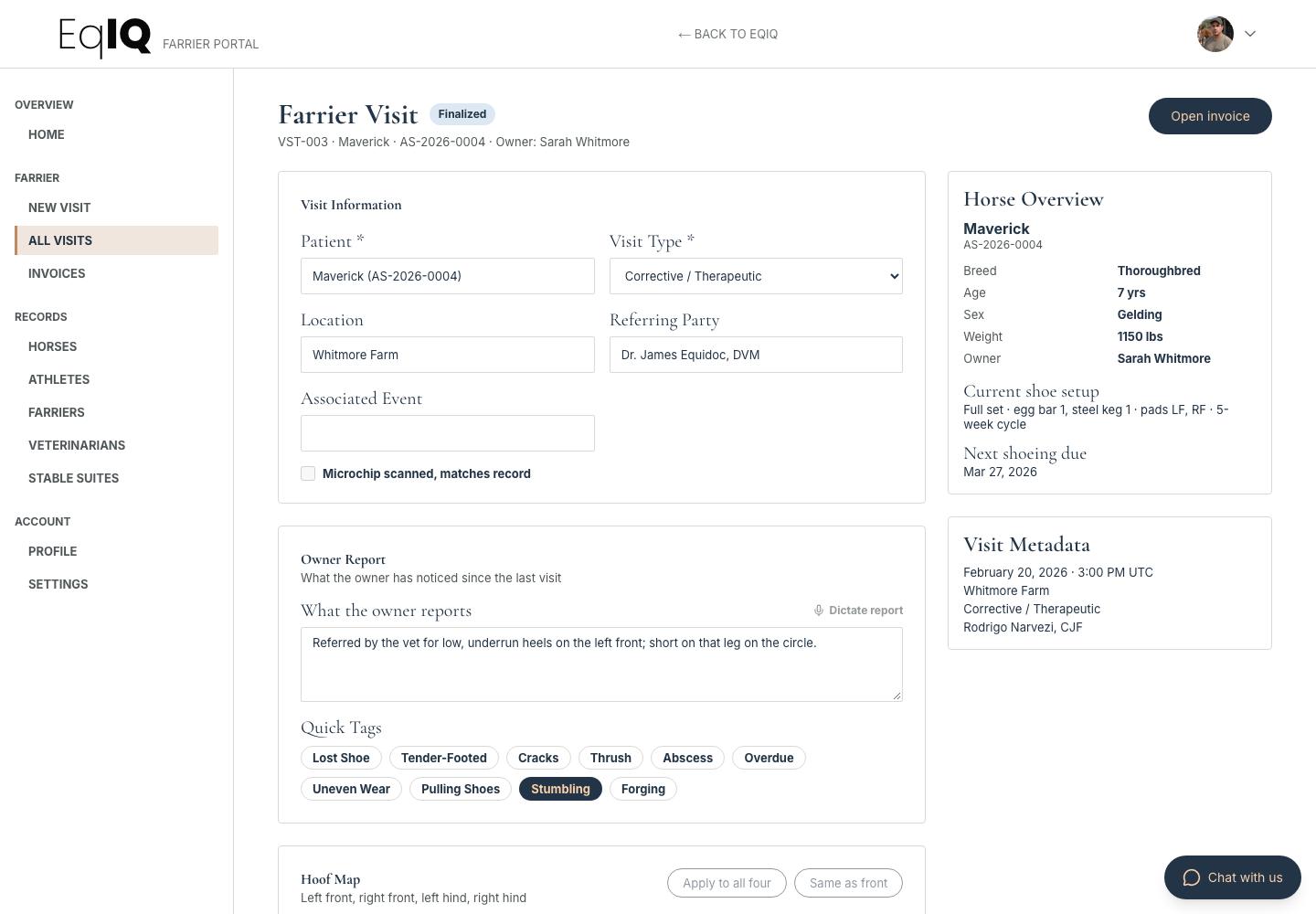
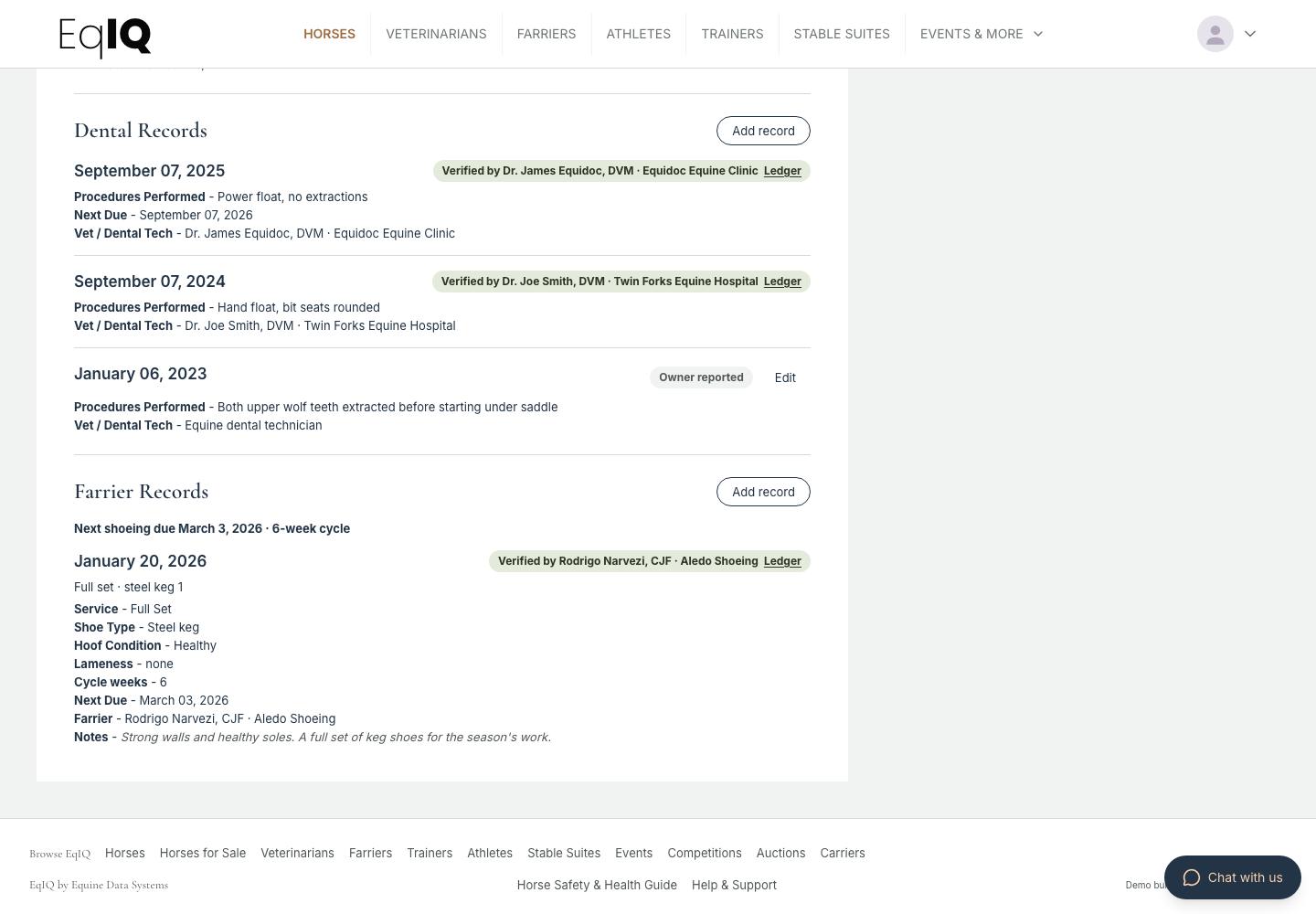
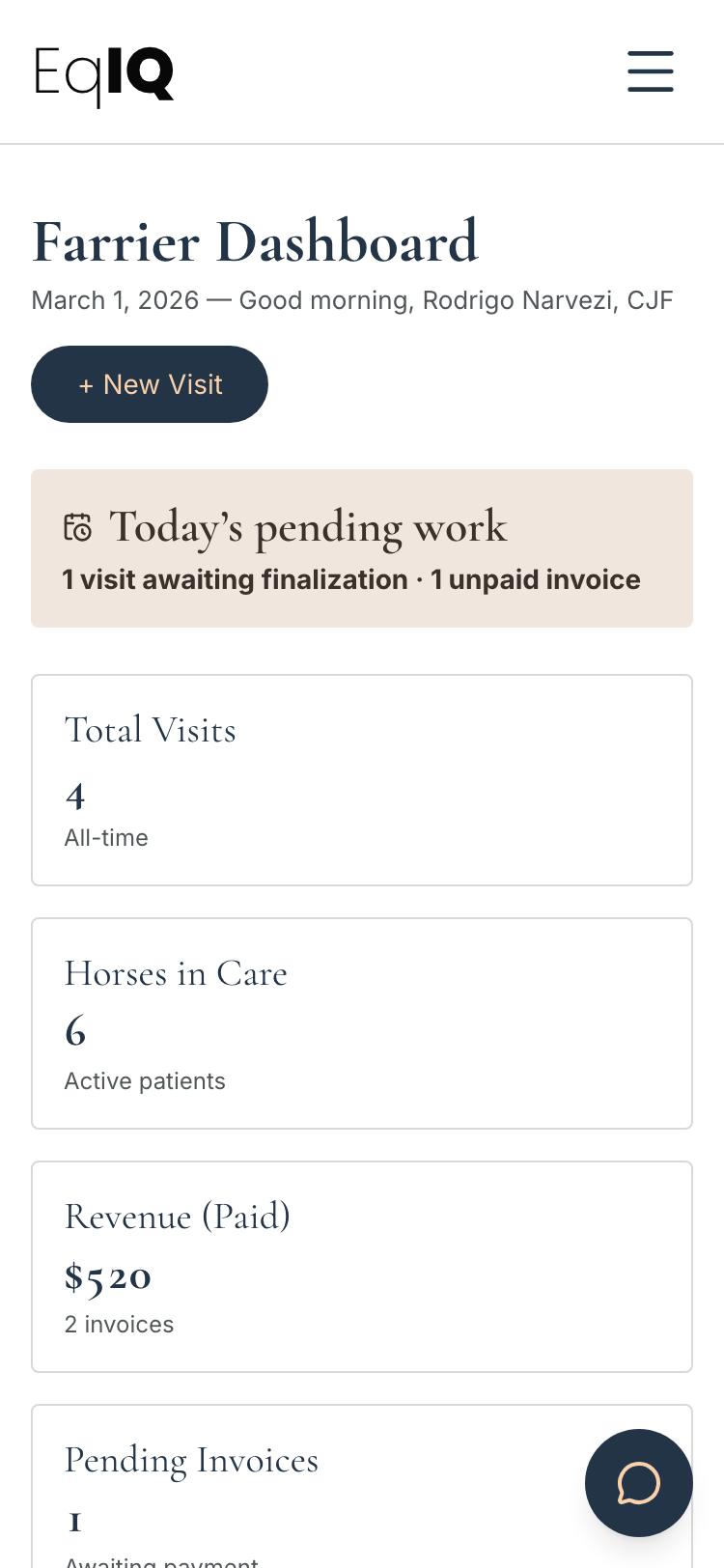
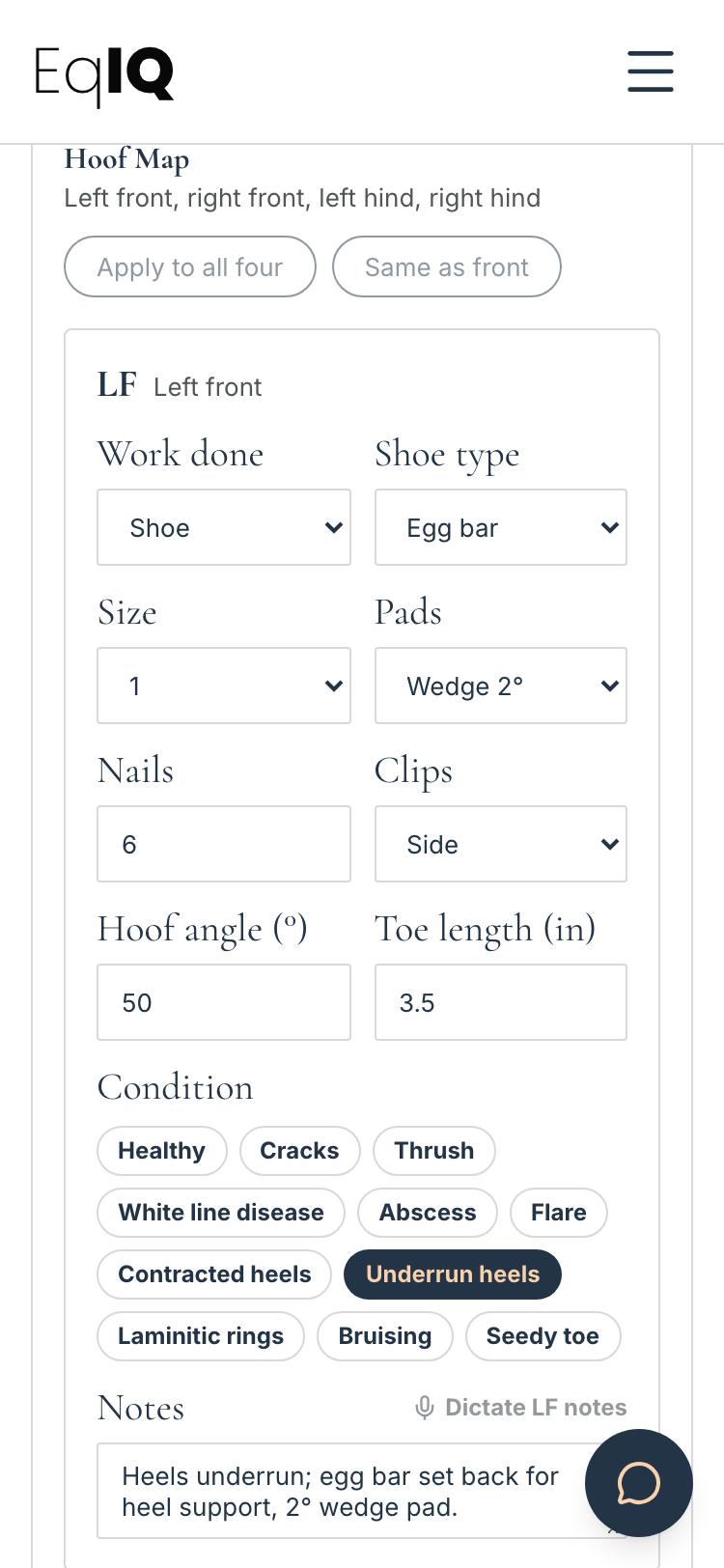
Vets and farriers hold the most trusted facts about a horse. Issue 1 gave the vet an office. Now the farrier has one too. It works the same way: write up the visit, press Finalize, and a signed record appears on the horse's page.
- A record for each foot. Left front, right front, left hind and right hind. Each one has the work done, shoe type and size, pads, nails, clips, hoof angle, toe length, condition and notes.
- A shoeing cycle. Pick the number of weeks and the next due date is worked out. The dashboard lists the horses coming due, and the owner sees the date too.
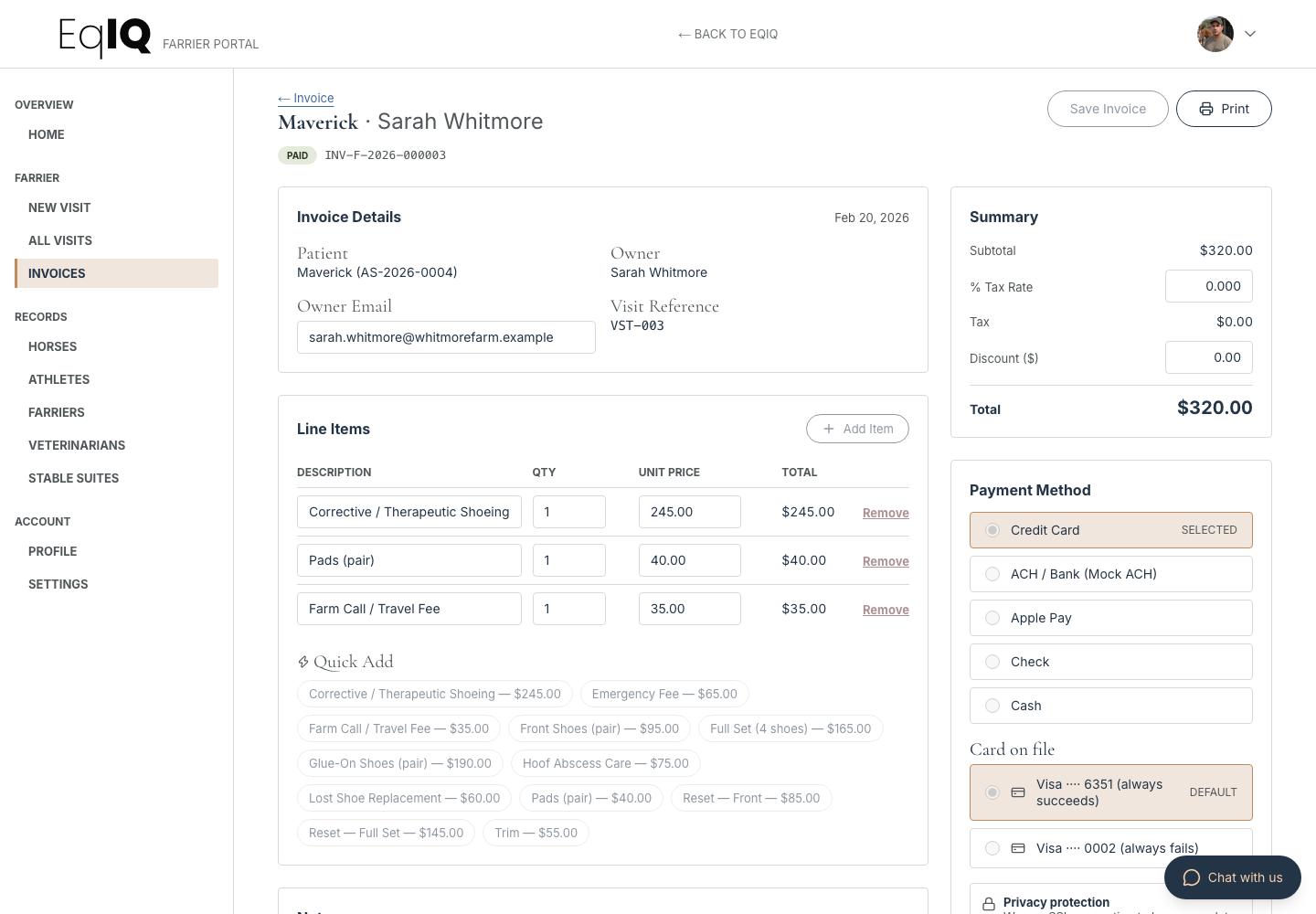
- Billing. A price list of farrier work, an invoice filled in from the visit, and a pay link for the owner. Payments are pretend.
- The right doors. A vet cannot open the farrier's workspace, and a farrier cannot open the vet's.
2. Ready to be found
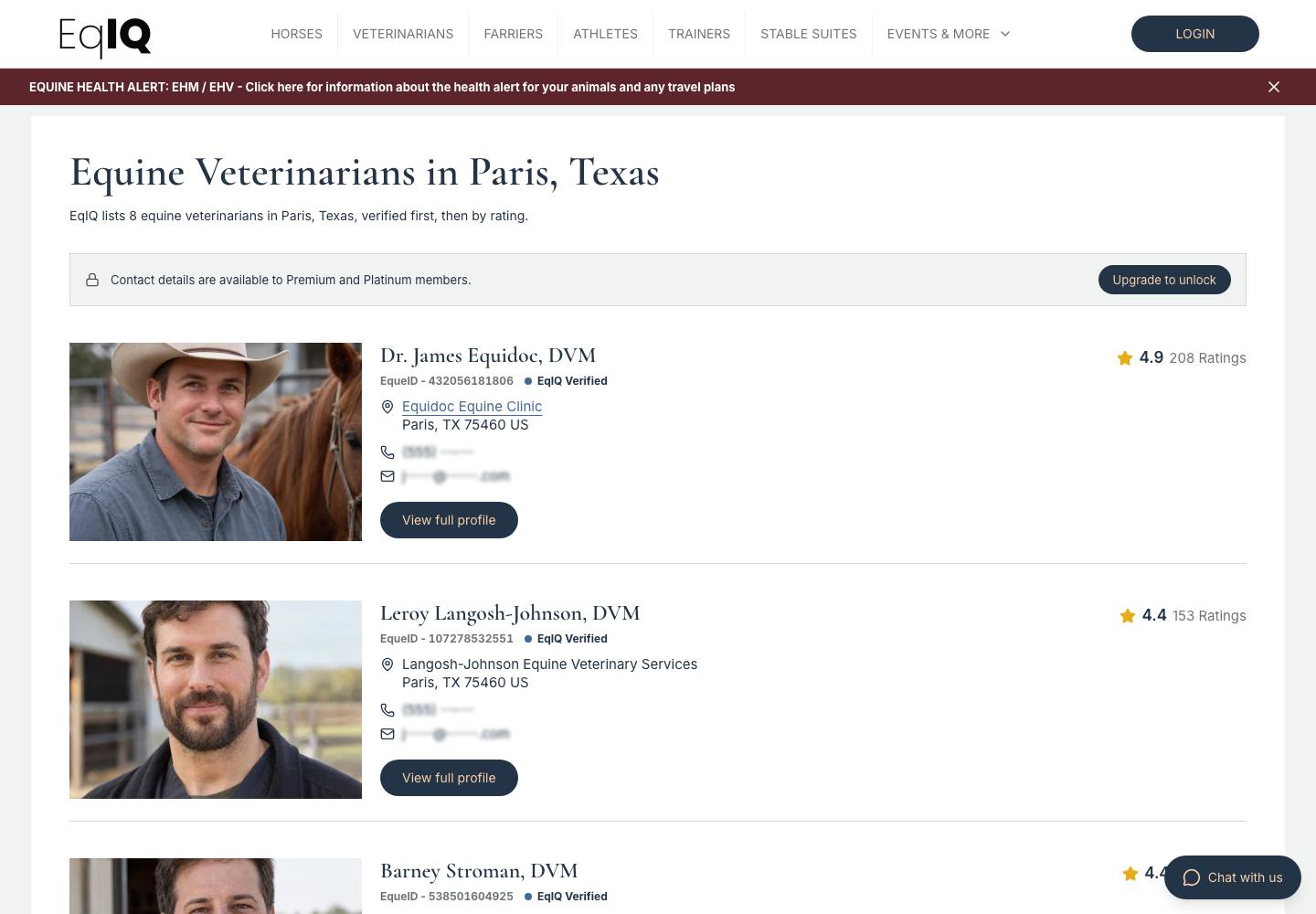
When someone types a horse's name, a vet's name, or "farrier near Aledo, Texas" into Google, or asks an AI assistant, EqIQ should be the answer. The whole site was rebuilt to earn that.
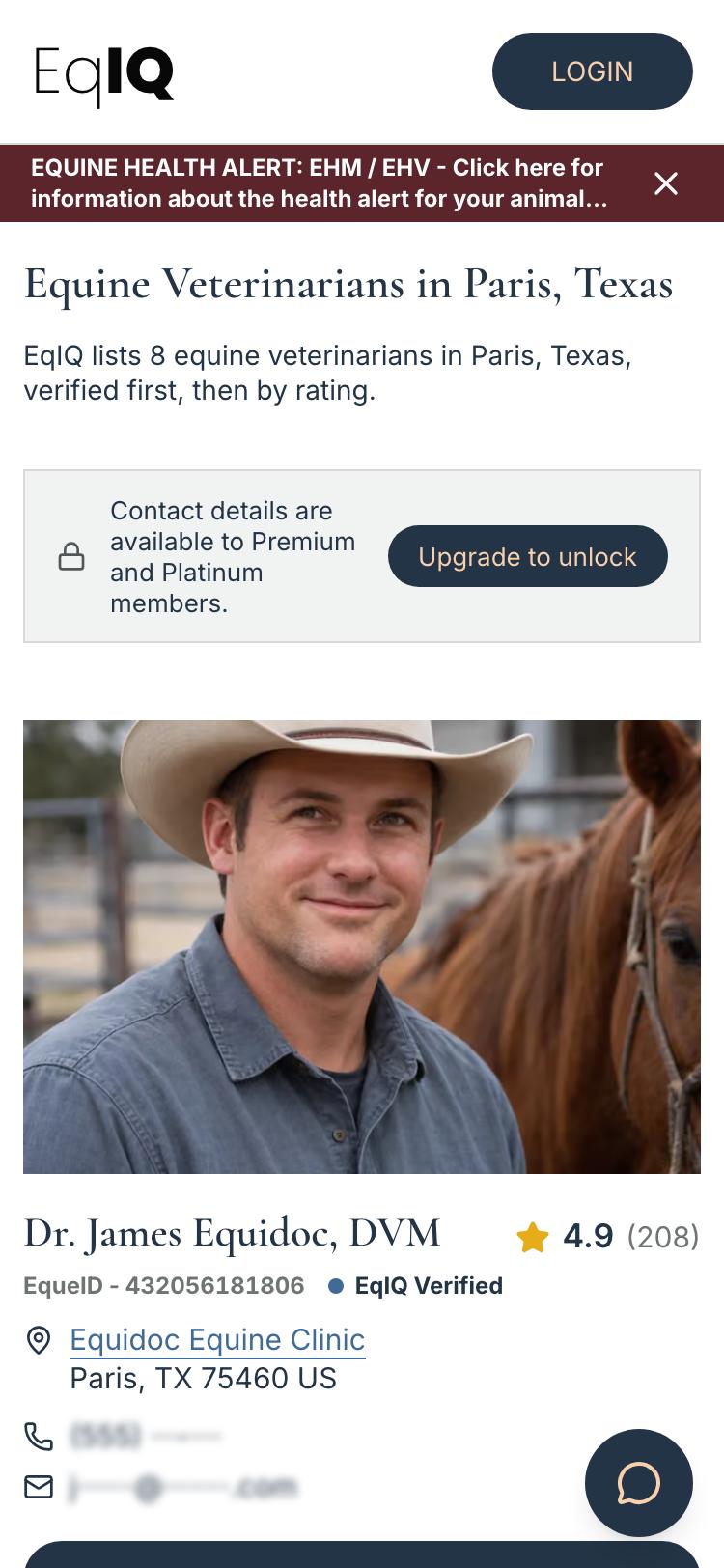
- Addresses you can read. /veterinarians/james-equidoc-dvm instead of a 12-digit number. 8,186 names were issued in three seconds. Old links still work, and an address never passes to someone else.
- Fast for visitors and for search engines. A signed-out visitor gets a saved copy of the page that refreshes the moment the record changes. It answers in about 60 thousandths of a second.
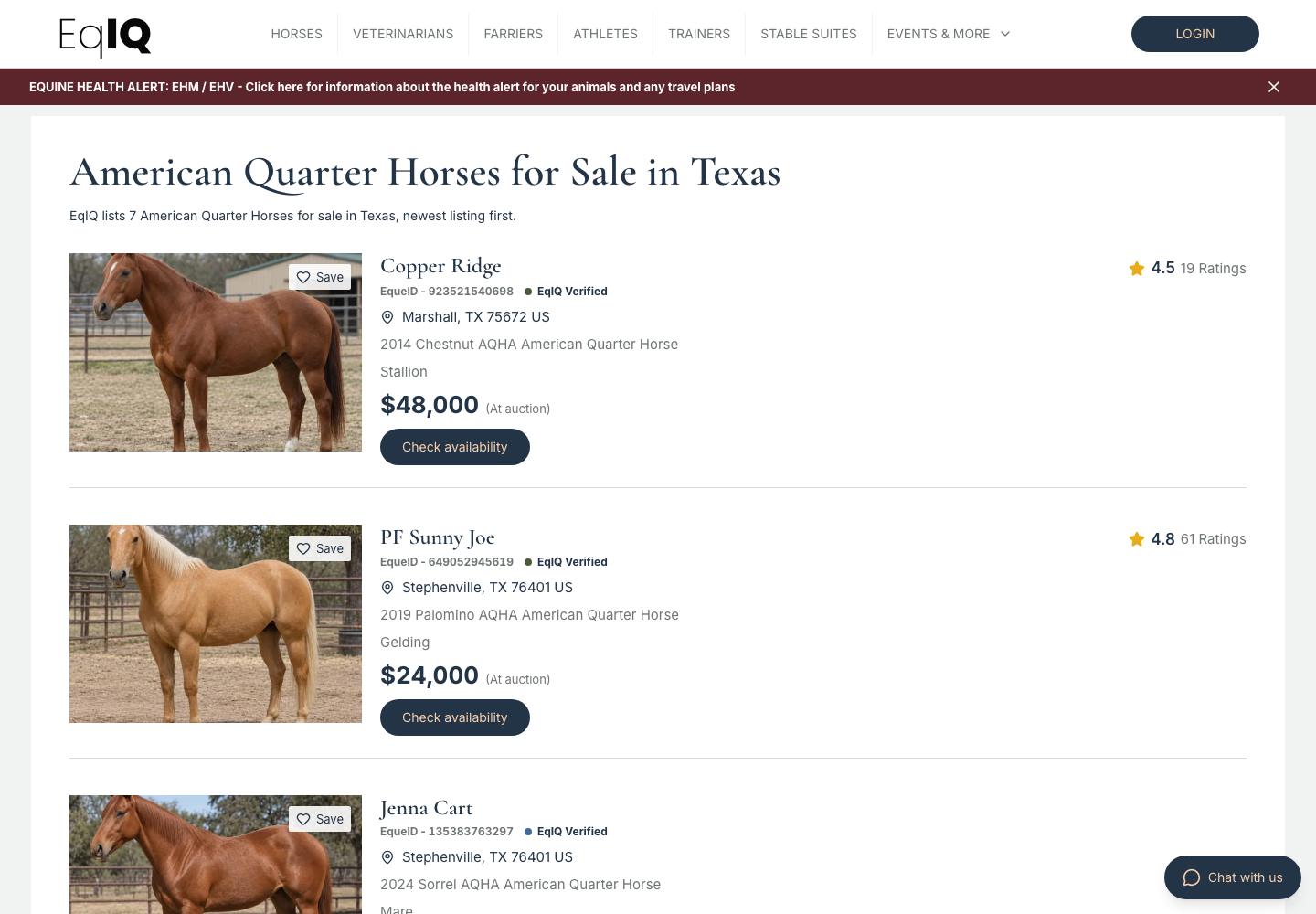
- New kinds of pages. Places ("Equine Veterinarians in Paris, Texas"), horses for sale, events by state, a horse's offspring, show venues, vet practices, stables, associations, and an A to Z list of horses.
- Labels for machines. A sitemap of 9,630 pages, titles and labels that search engines read, a one-line fact summary under each name, share pictures, and a guide written for AI assistants.
- Off until it is real. None of it is visible to search engines yet, on purpose. The demo's people and horses are made up, and they should not show up as real vets in real towns. One switch turns it all on at launch.
3. A face for every professional
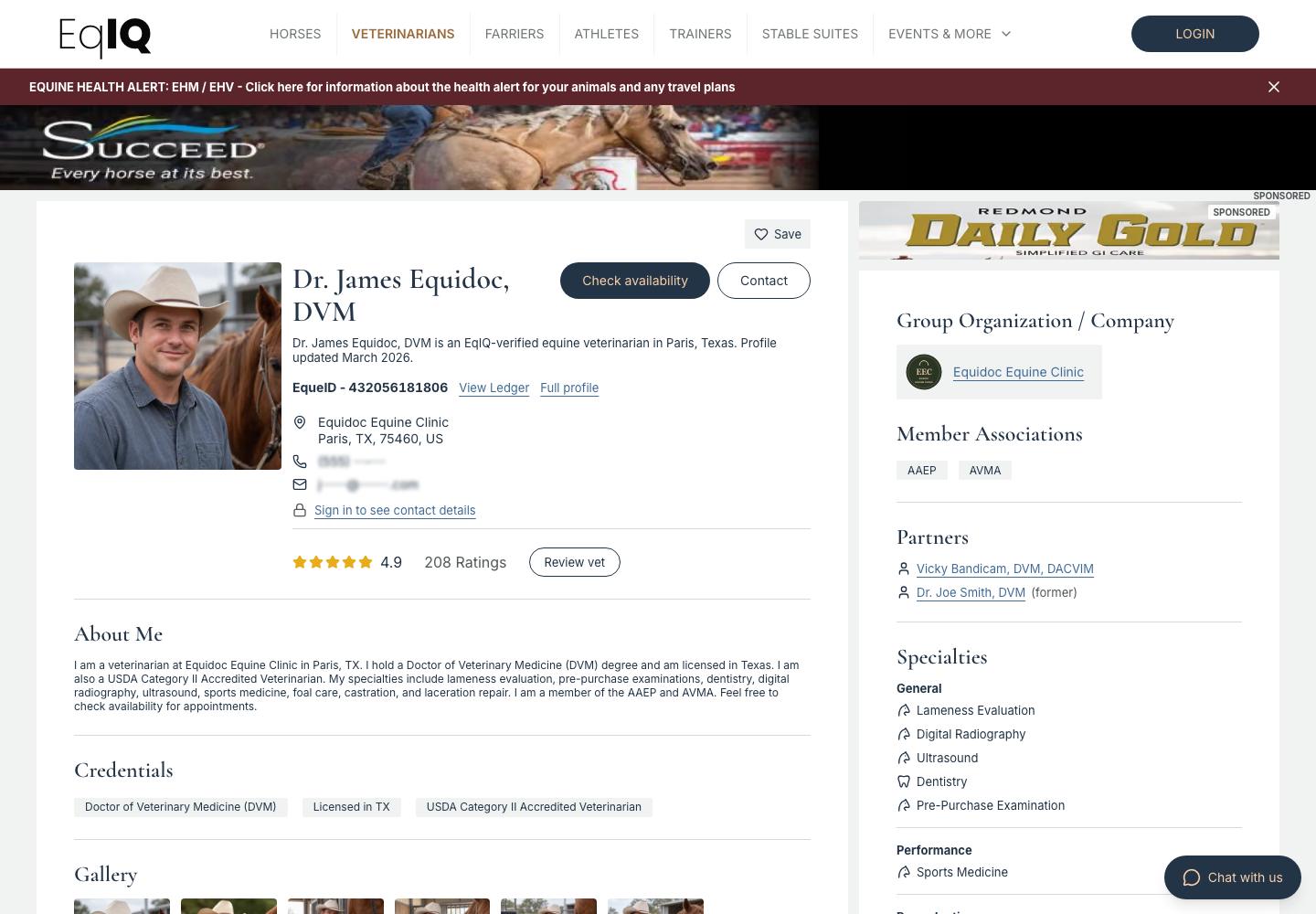
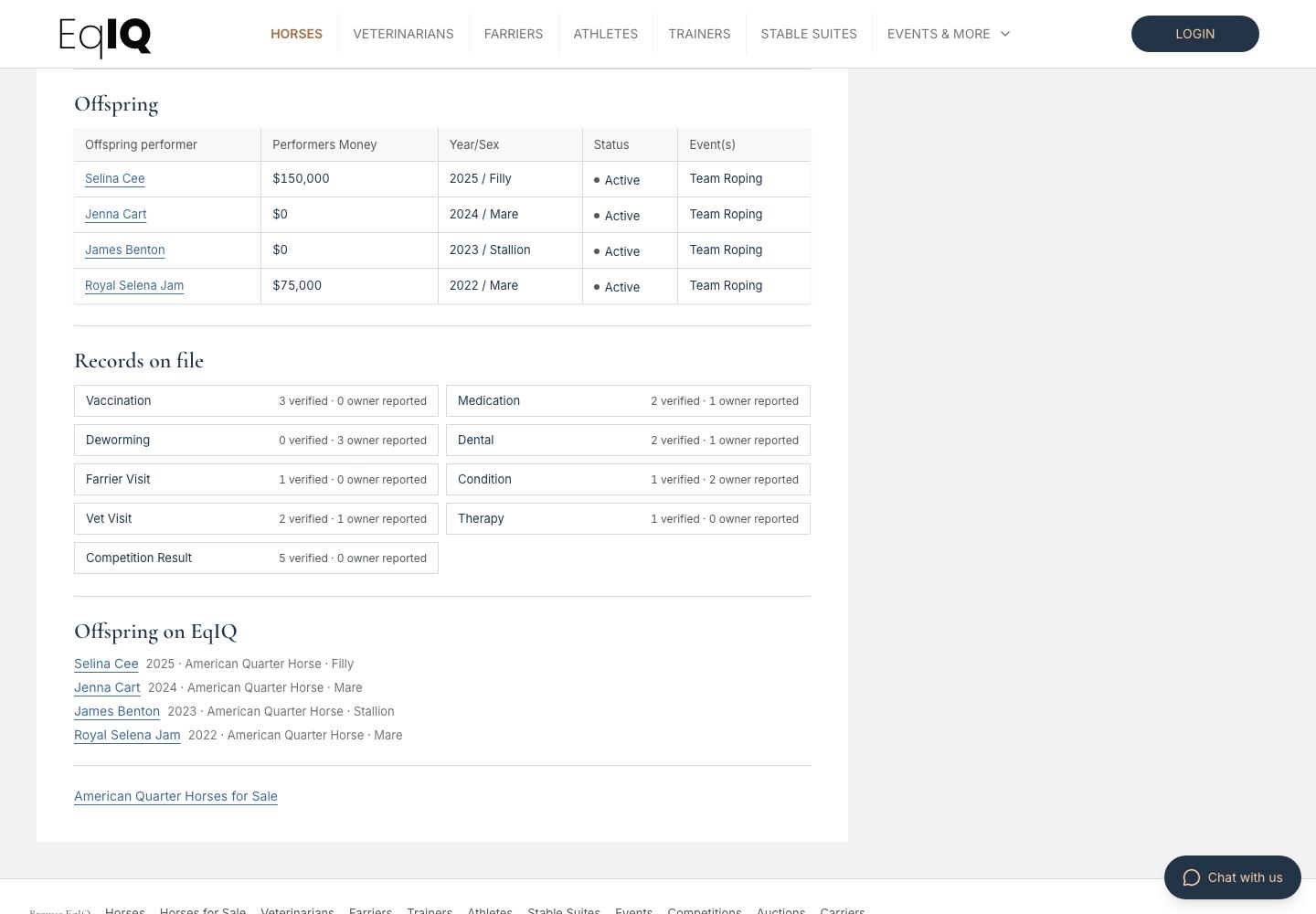
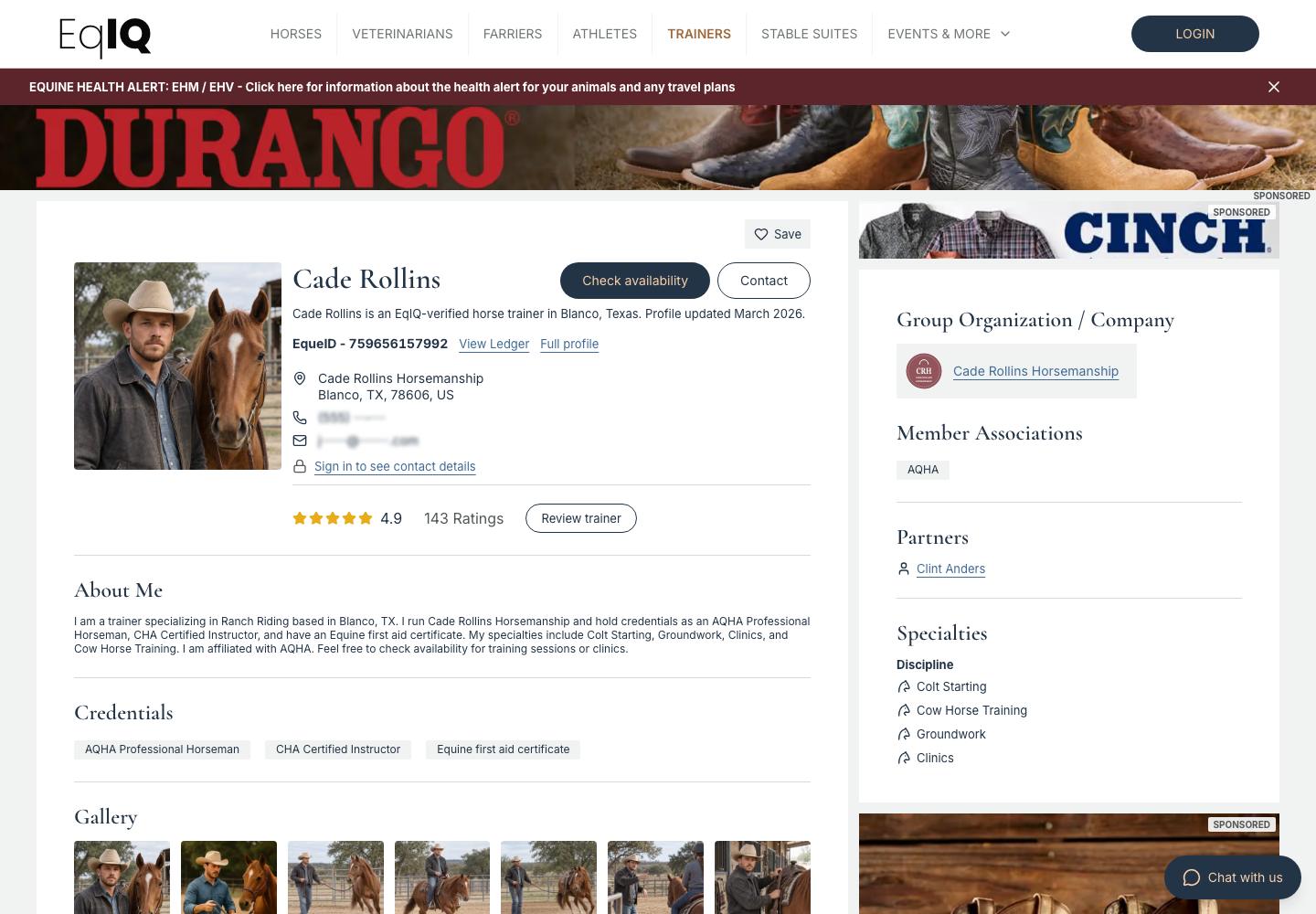
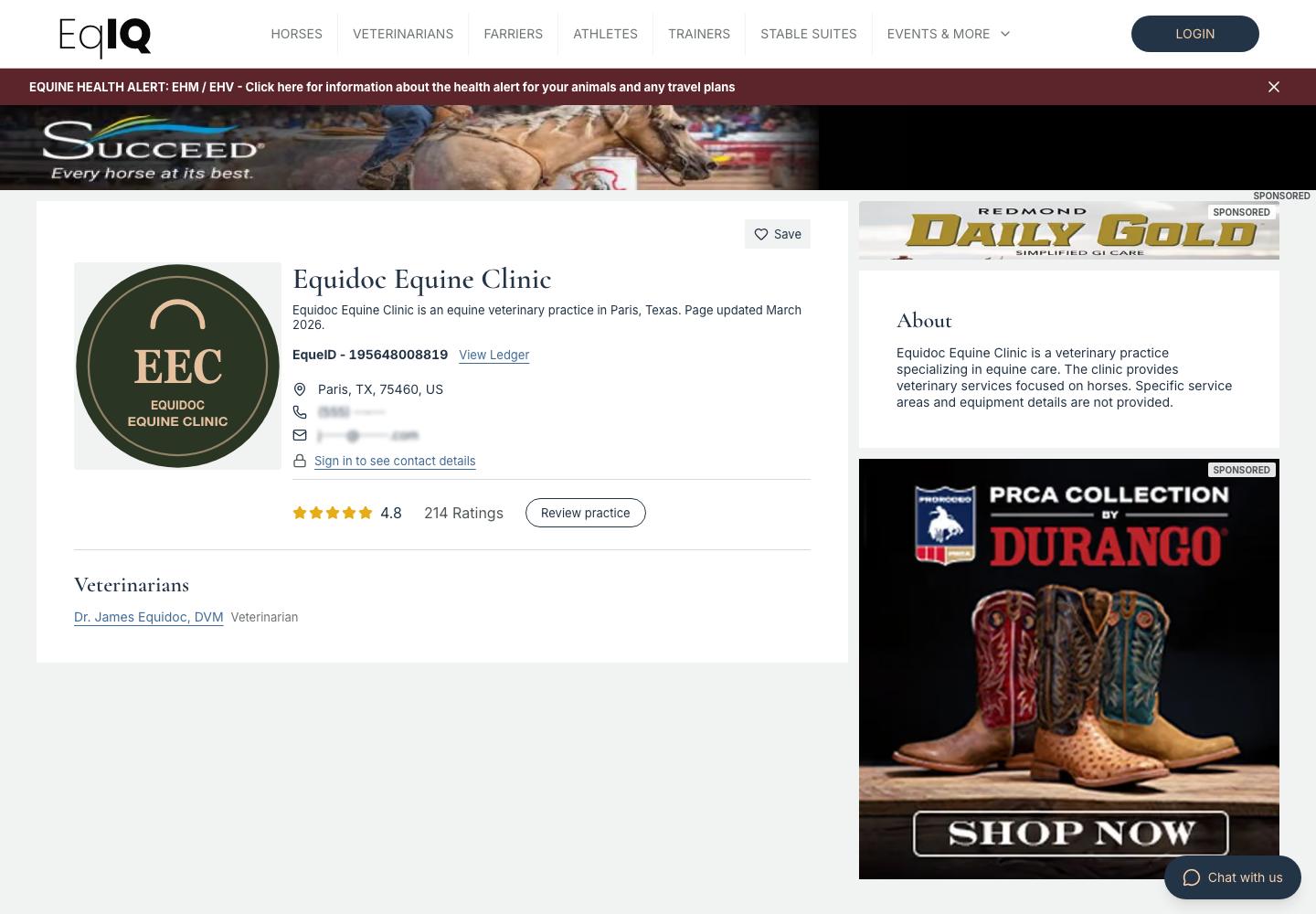
The design file shows profiles full of photos, careers, credentials and logos. More than a thousand professionals in the demo still showed a gray placeholder. "Phase 6" filled them in.
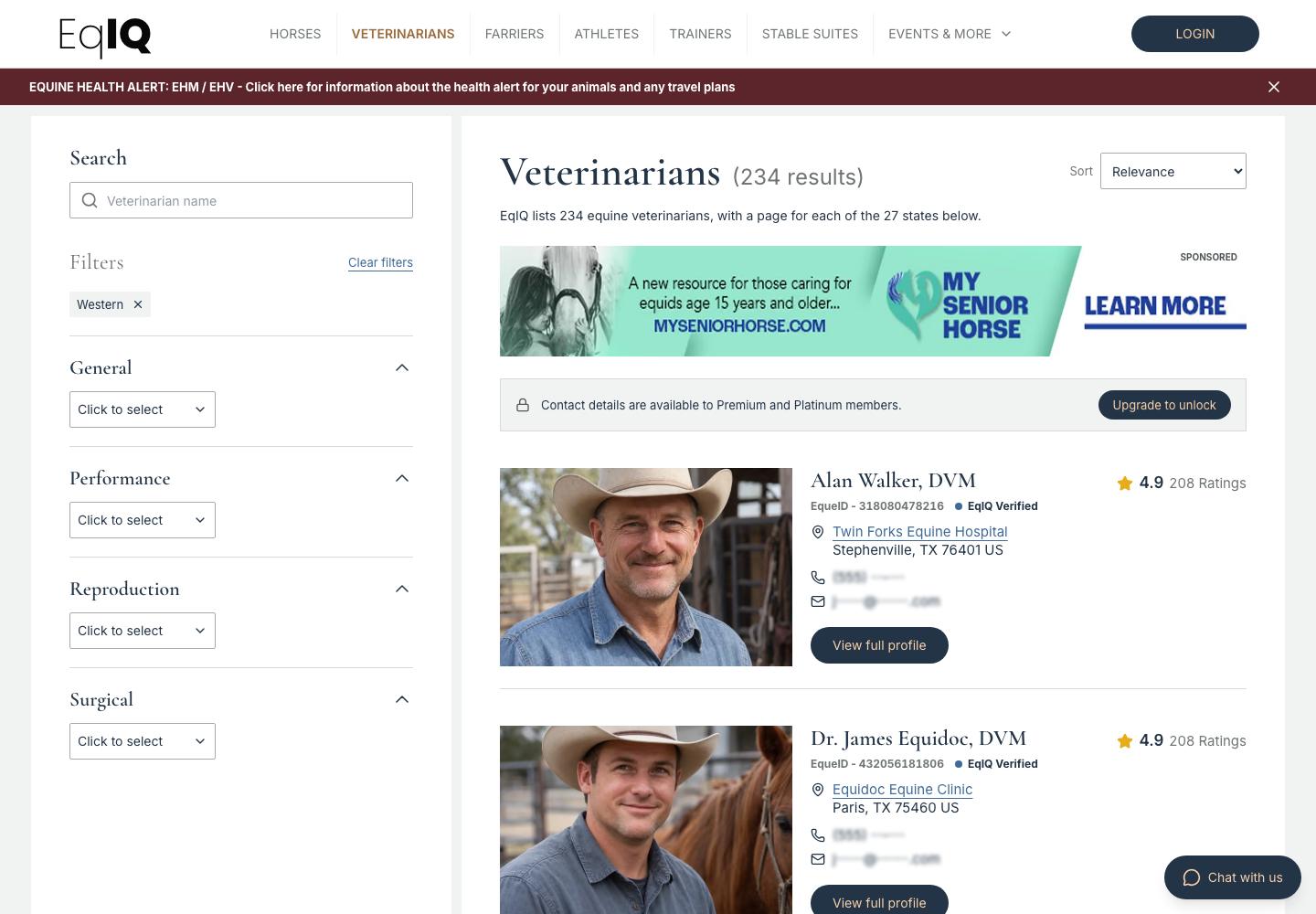
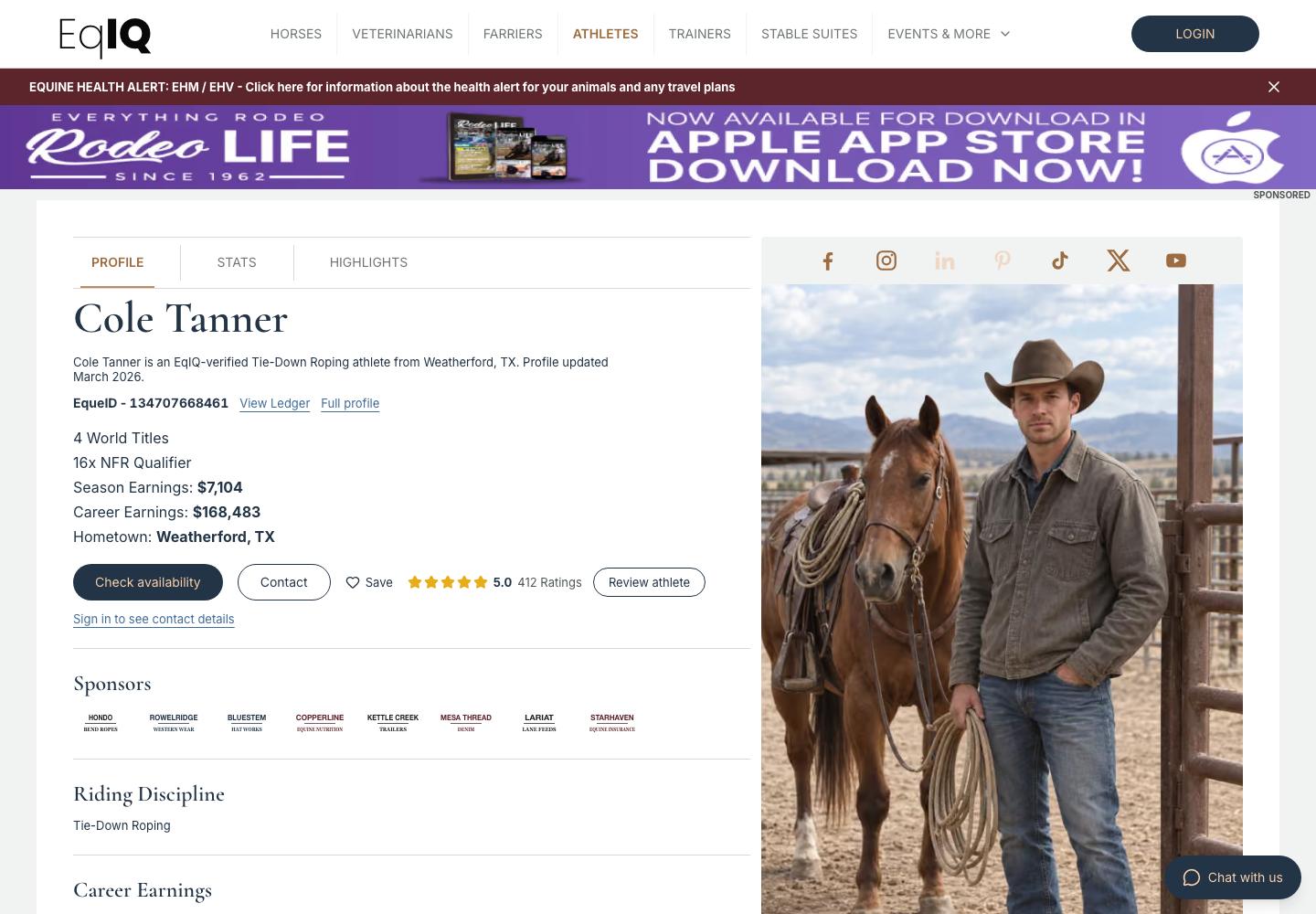
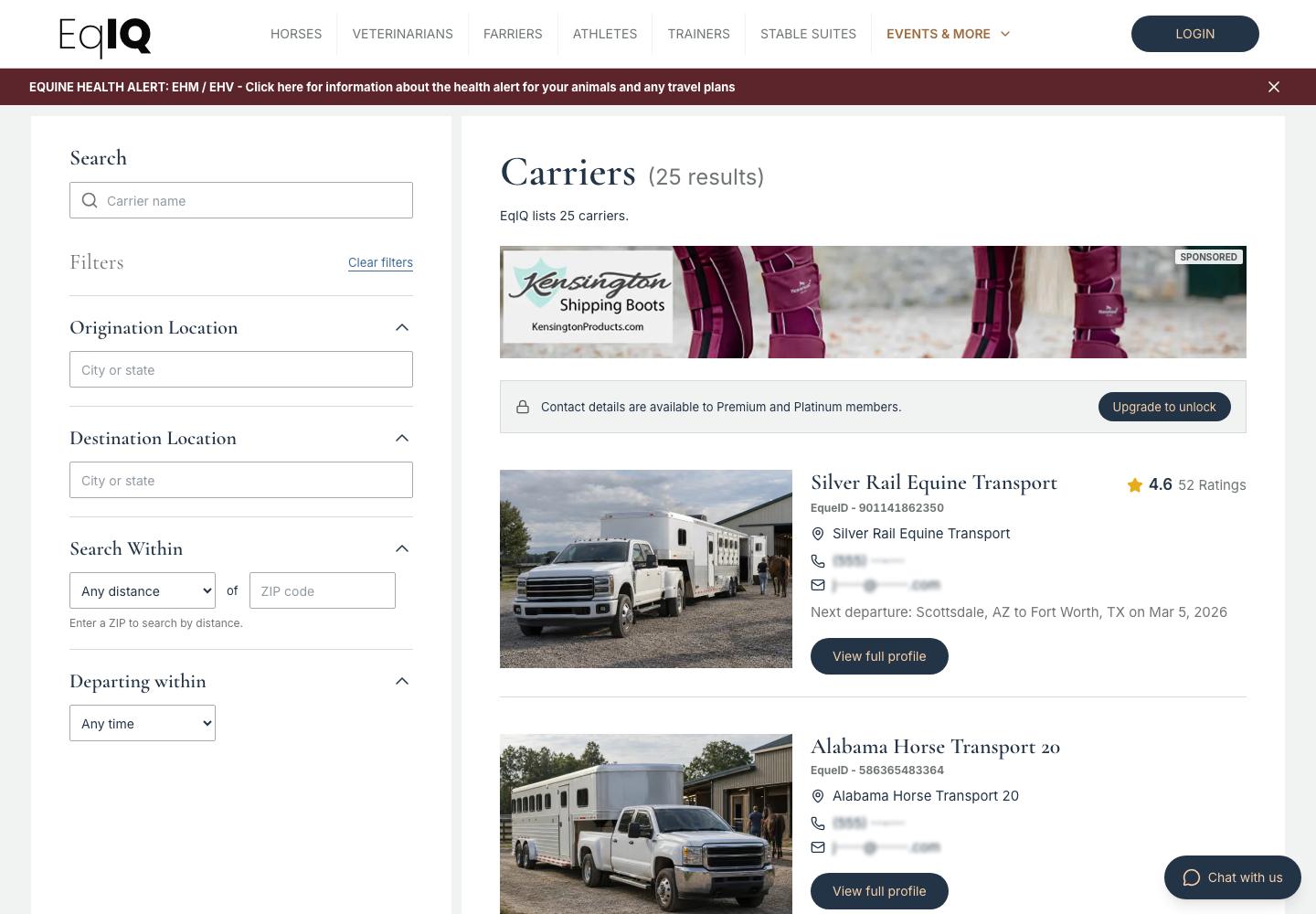
- 2,449 new pictures for $162. 1,061 headshots of vets, farriers, trainers, athletes and drivers, 25 truck-and-trailer photos, 332 athlete portraits and 1,031 gallery photos. A second AI checked every picture before it went up, and 125 were redone.
- Every first page has a face. On the first page of results for vets, farriers, trainers and athletes, 33 of 160 people had a photo before. Now all 160 do.
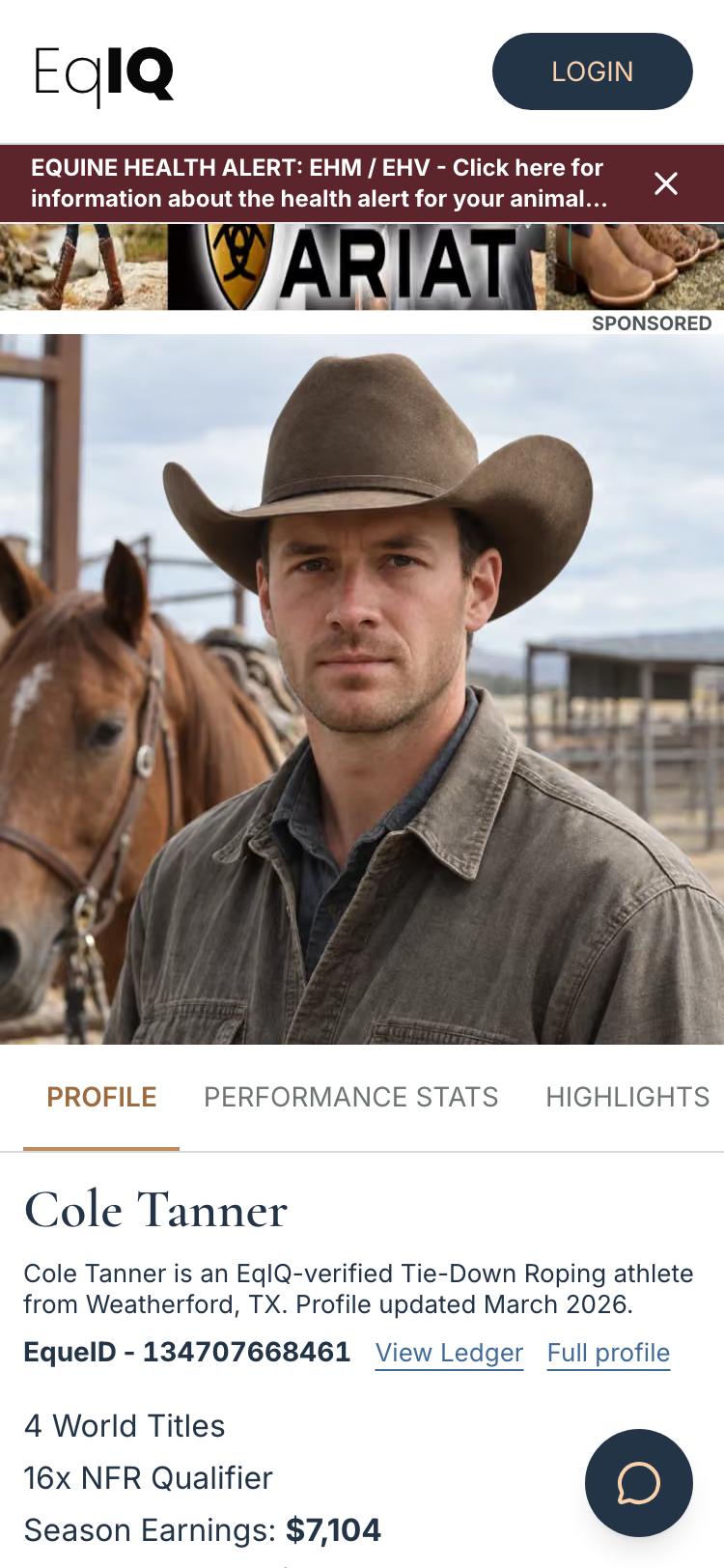
- Careers and credentials. Rodeo athletes have rides, results and earnings. Every vet, farrier and trainer has three credentials. Practices and stables have logos, drawn in code.
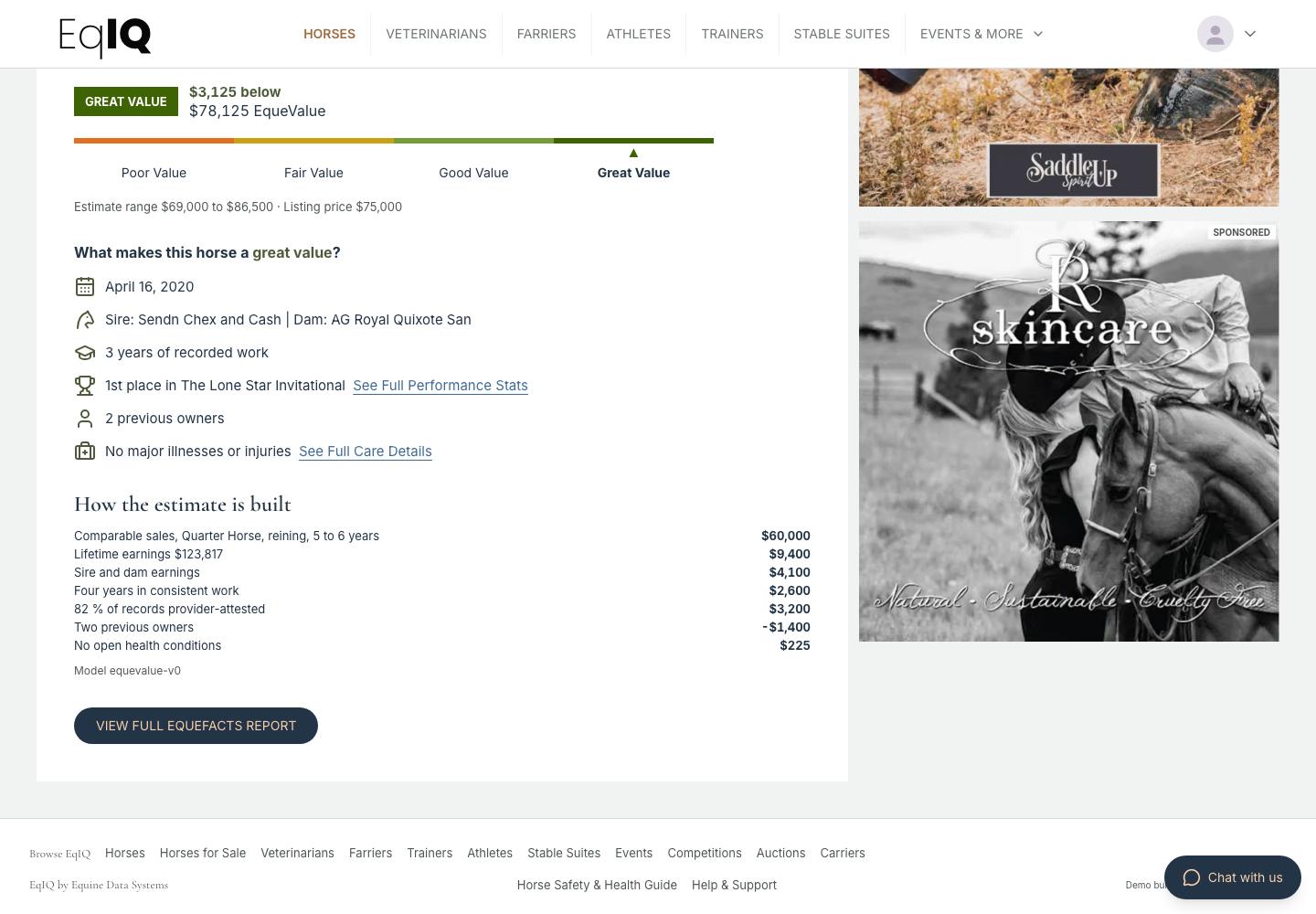
- Prices with something to compare to. 240 sample sales of grown horses give EqueValue real comparisons, at the price ranges Karl set.
- Sample data, clearly. These photos and texts were made by AI for the demo. Real members will bring their own.
4. Person pages and privacy
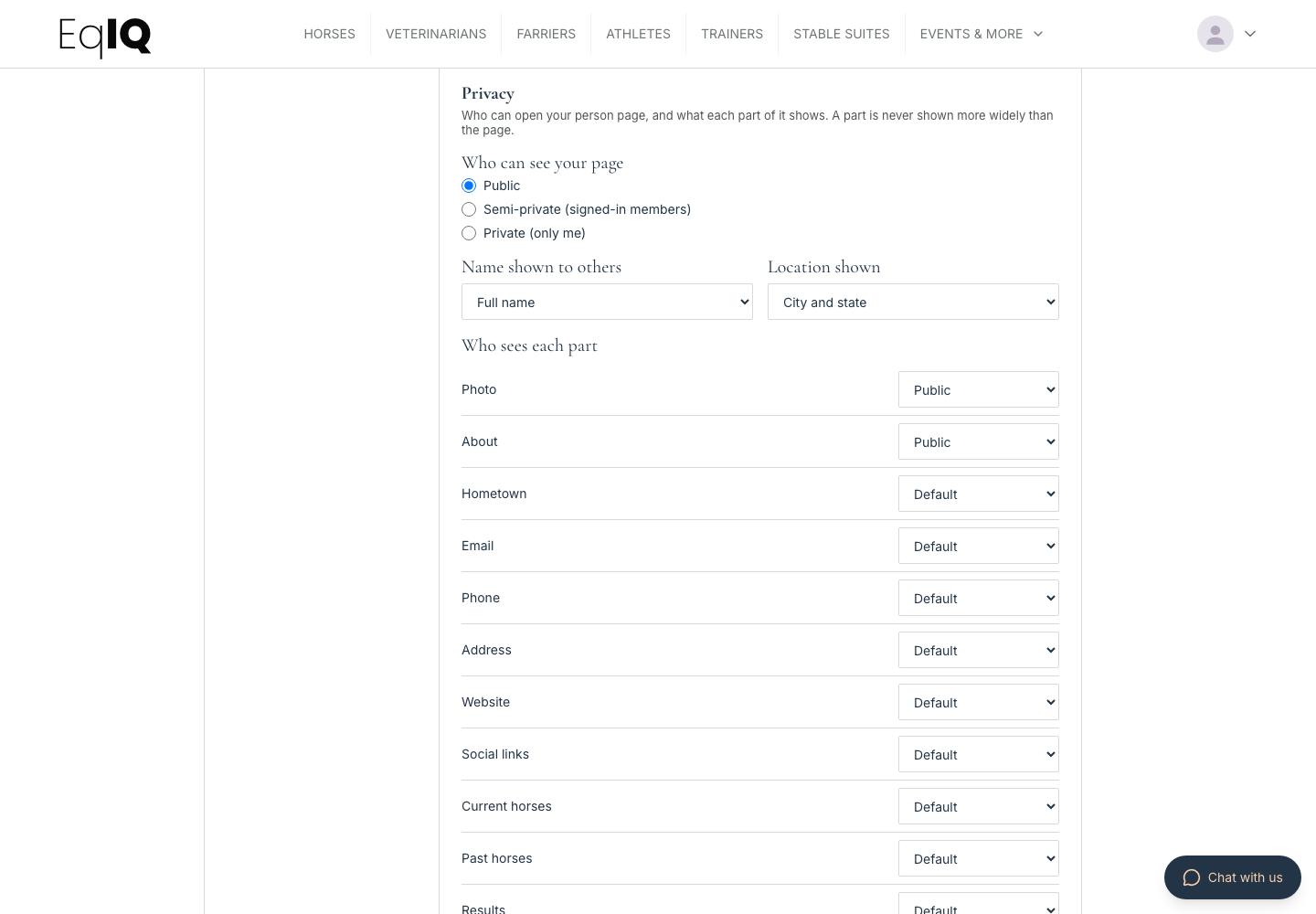
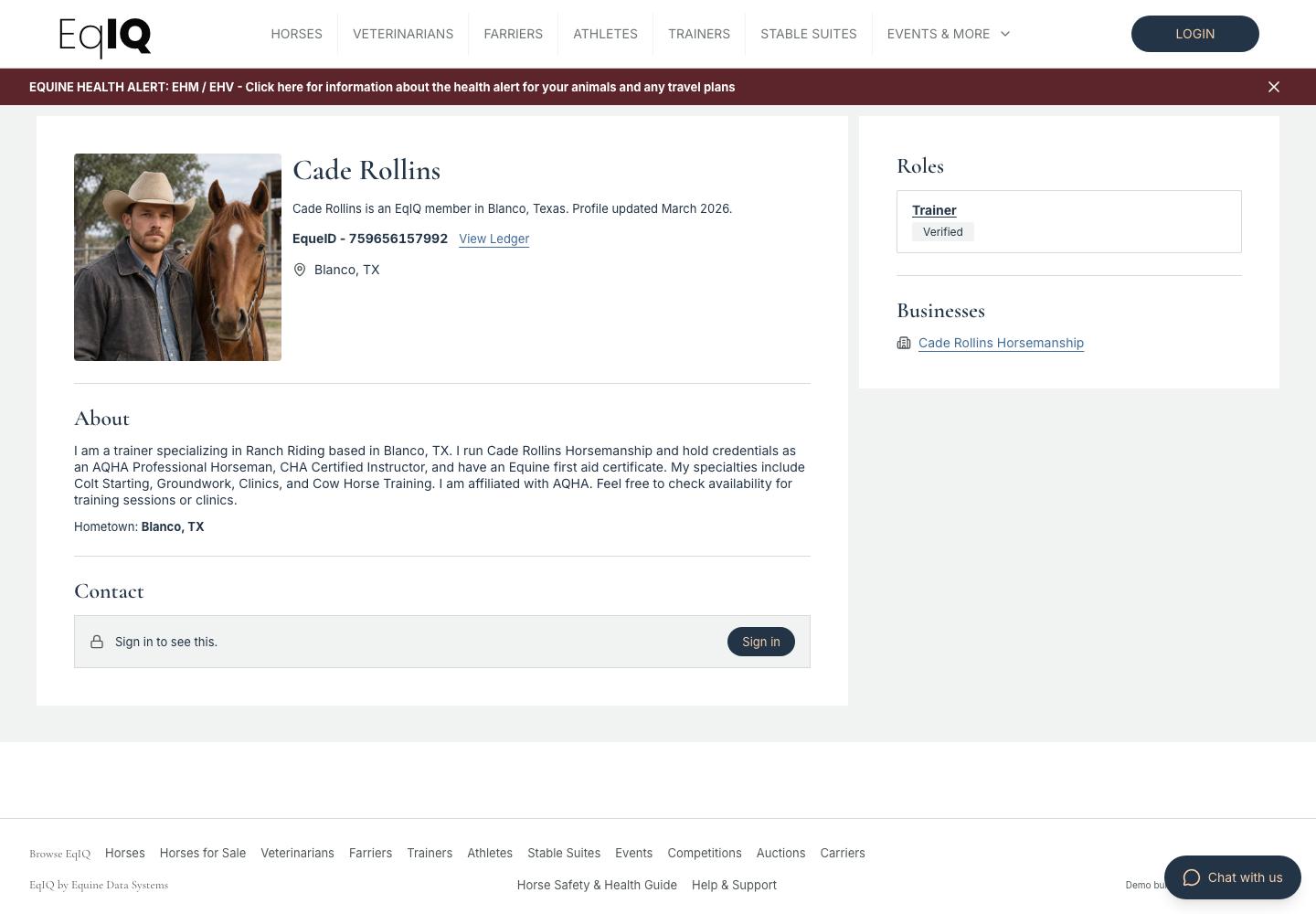
Owners, buyers and sellers had no page of their own. Now every person does, and each person decides how far it reaches.
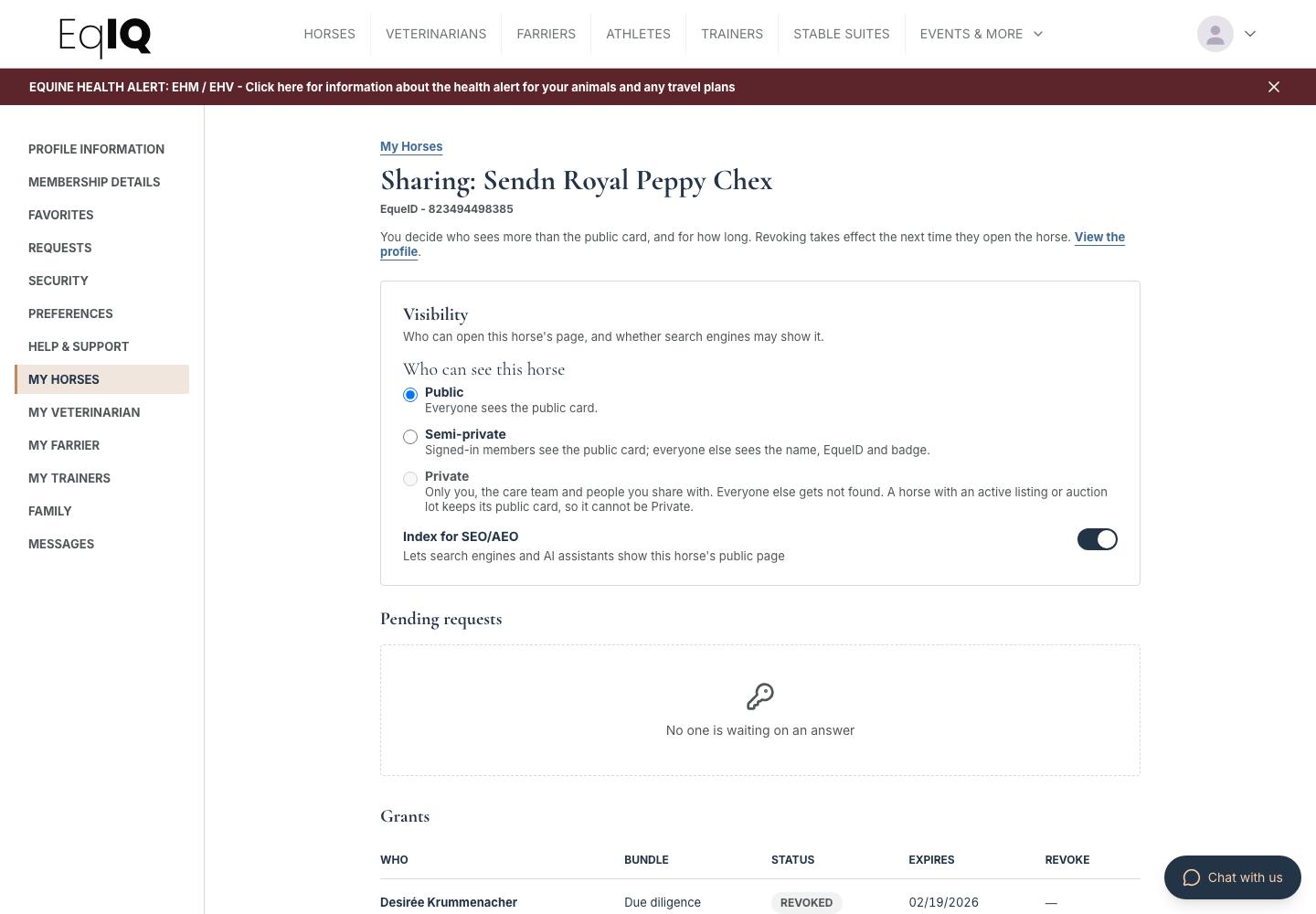
- Three settings. Public (anyone), Semi-private (signed-in members) or Private (only me). They can be set for the whole page or field by field. Horses get the same settings, except that a horse for sale cannot be Private.
- A search-engine switch. Separate from who can see the page is whether search engines may list it. New adult pages start with it on.
- Children are protected. A child's page starts closed to search engines, and only a parent can change that. A parent can always see their own child's page.
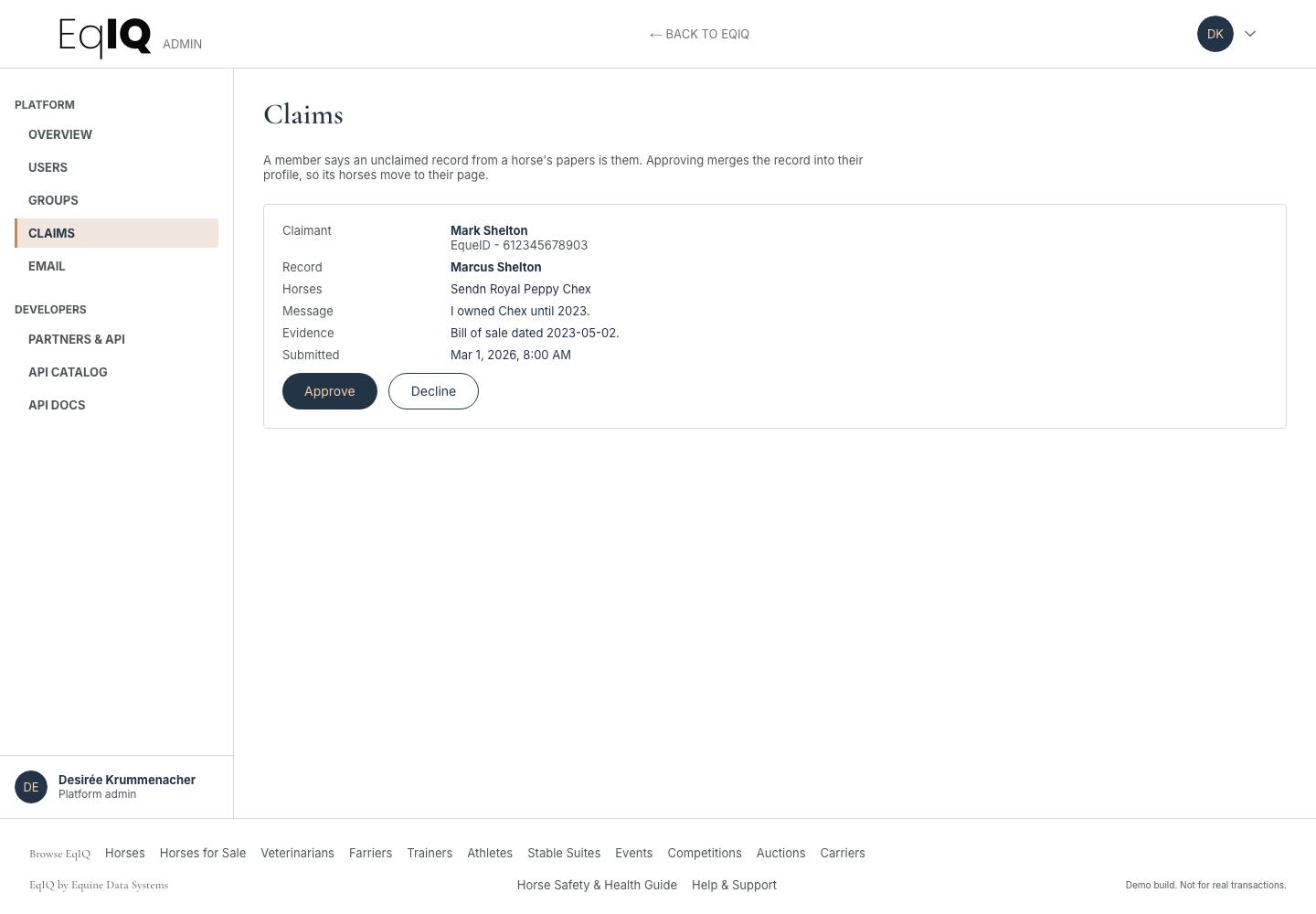
- Claim your page. A past owner named in a horse's records gets a stub page. If that person joins, they can claim it, and an admin approves the claim.
- Gaps caught before launch. Reviews and the security check found a few places where a page could show something a person had set to private, such as a photo, contact details or a members-only page. All were fixed.
5. Emails to members
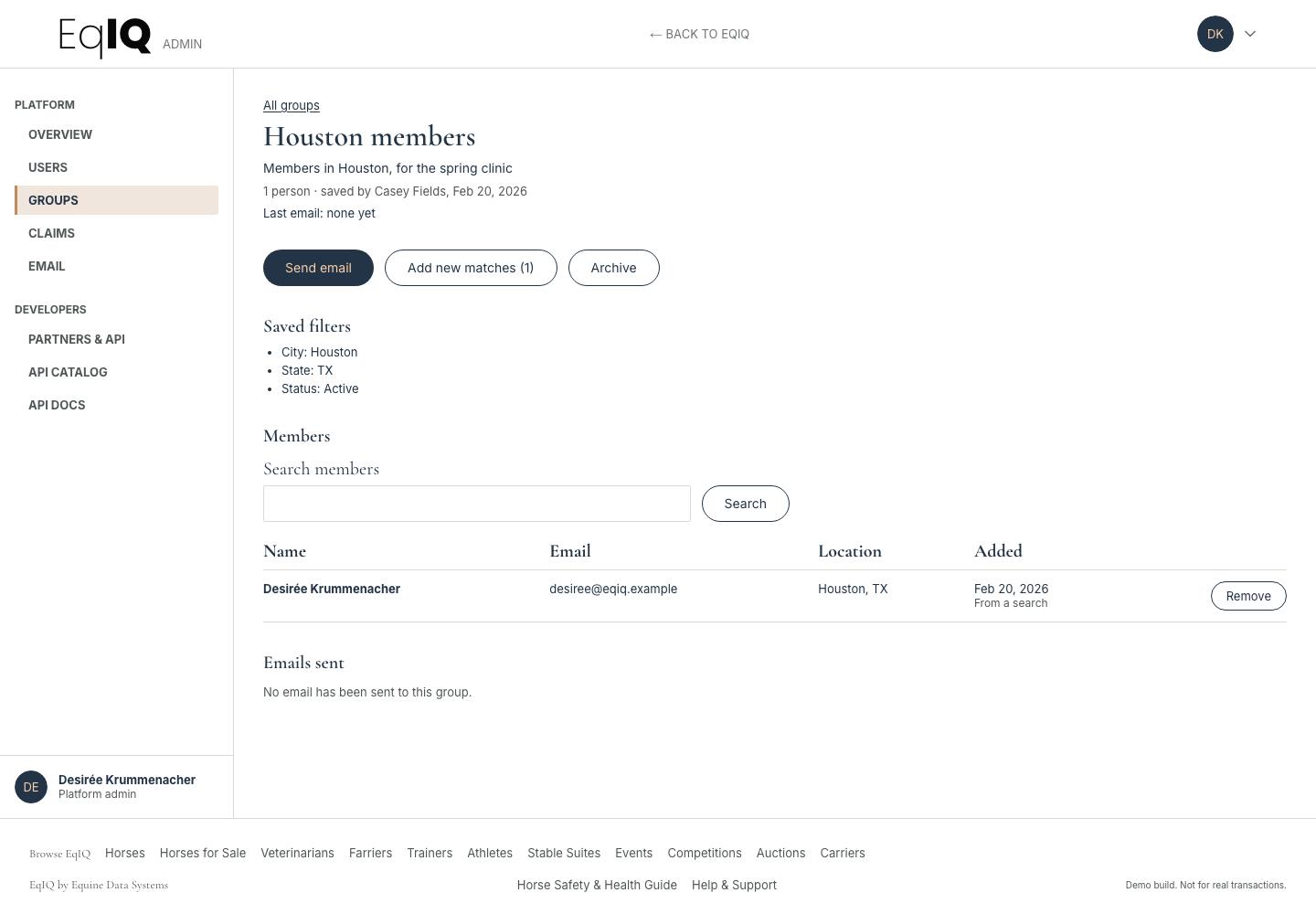
Issue 1 gave EqIQ branded email. Now admins can use it to talk to members, carefully.
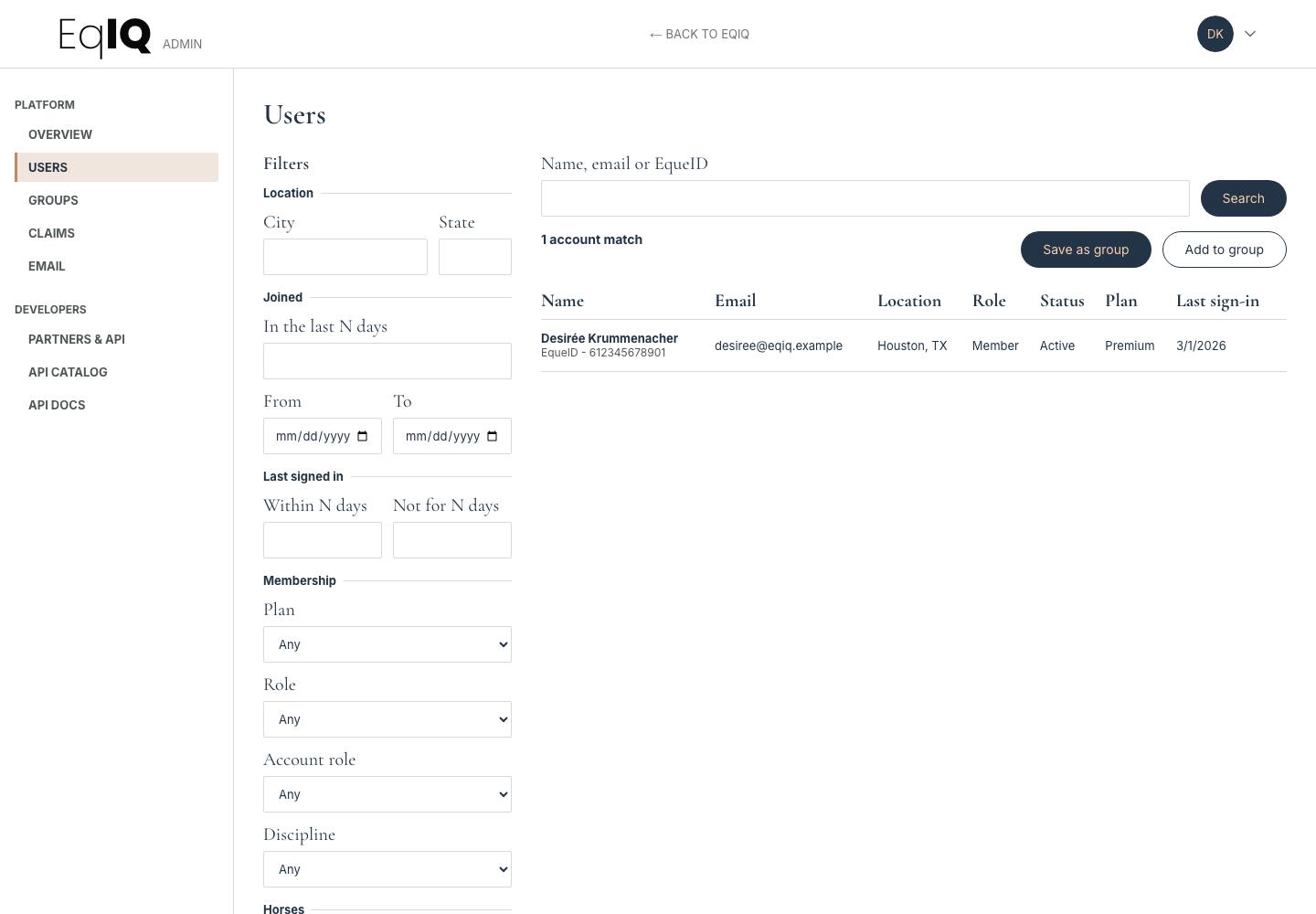
- Find members, save a group. More than a dozen filters, such as city, state, plan, role and how recently someone joined. The list can be saved as a group. Filters answer in under half a second, even with 10,000 extra accounts.
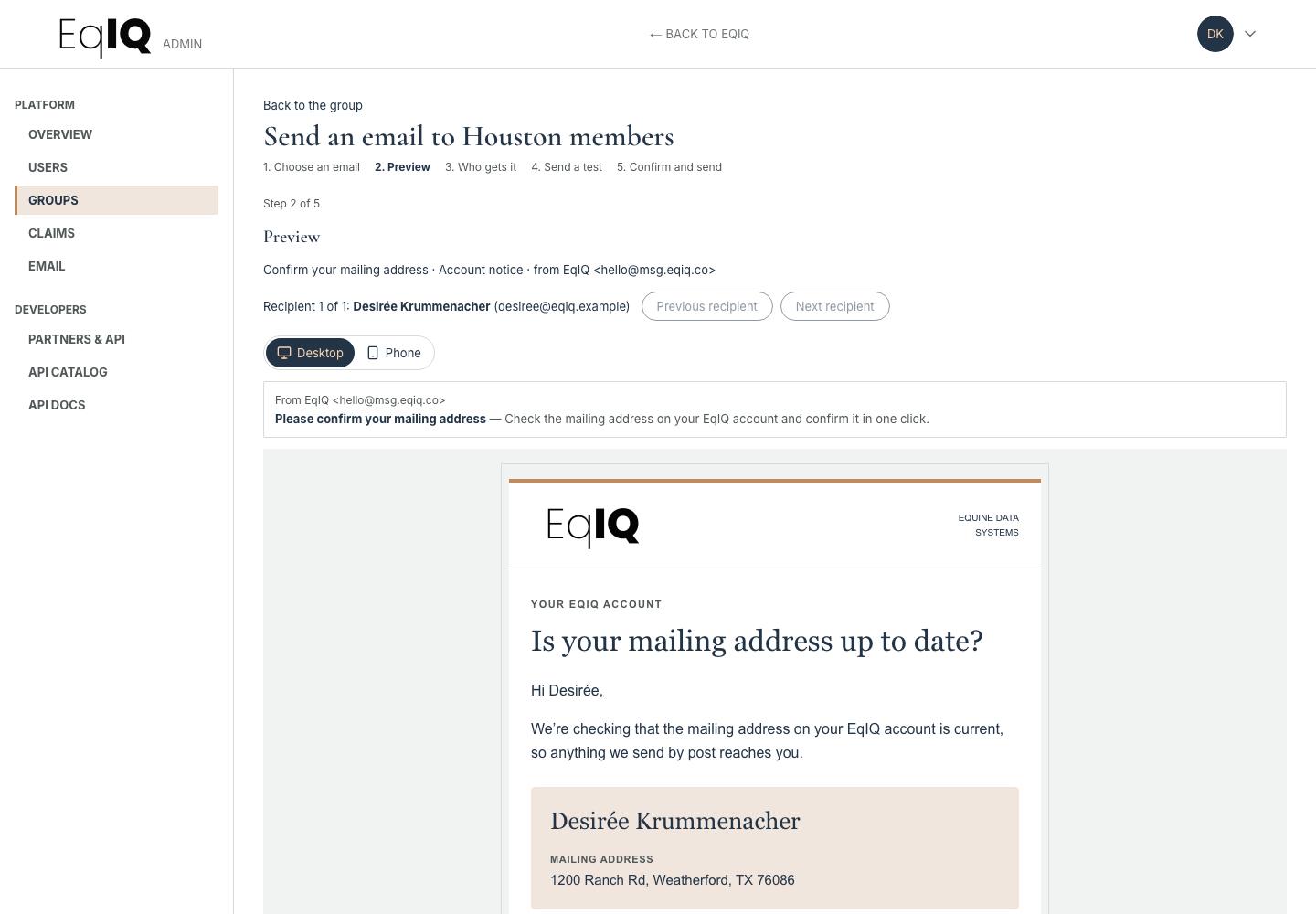
- Emails that fill themselves in. Twelve sets of fill-in values, such as the reader's name, their horses and their vet's practice. Private details, like a home address, go only to that same person and never into a subject line.
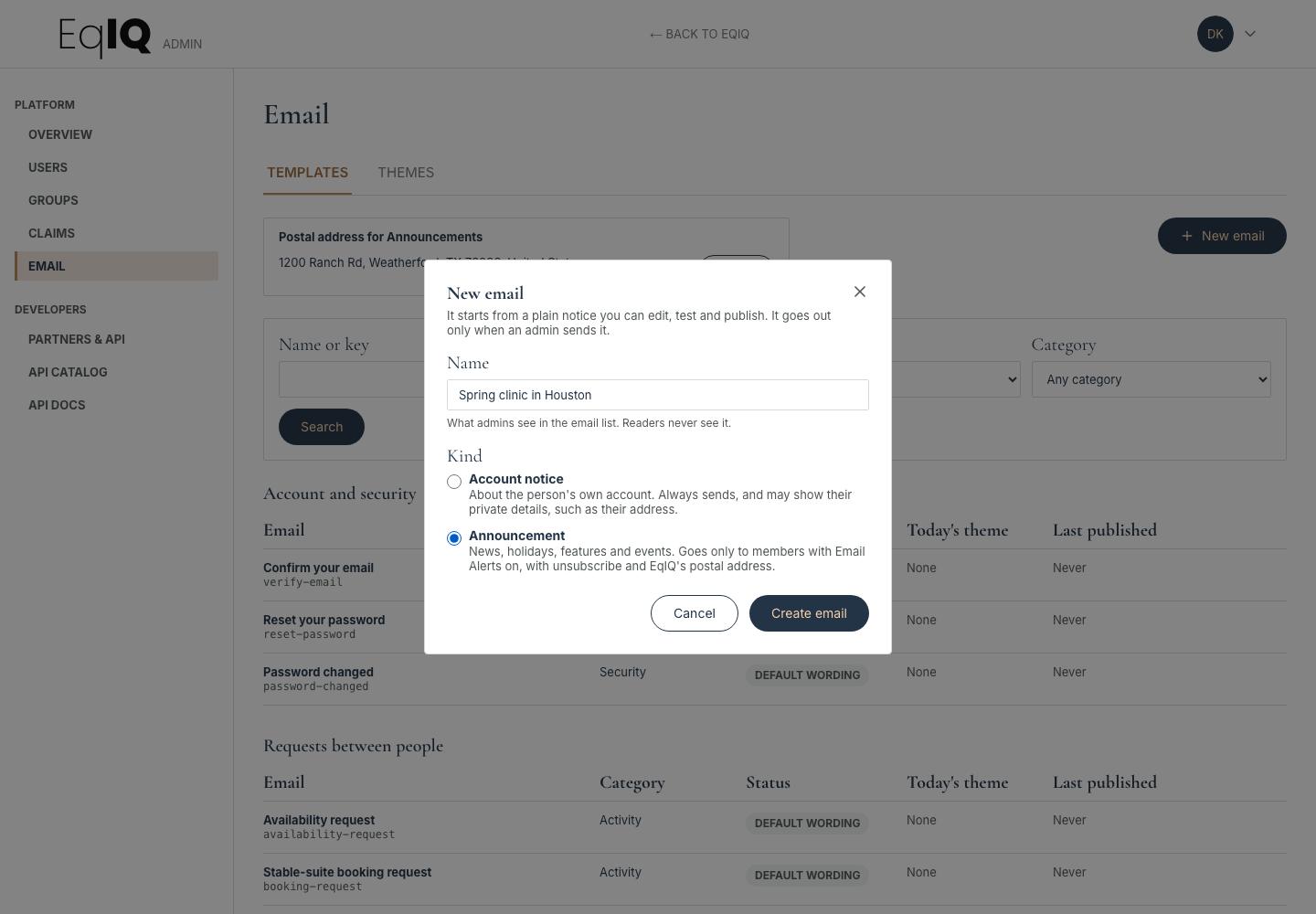
- Write and send. An admin can write an account notice or an Announcement. Sending takes five steps: pick the email, preview it as a real reader sees it, check who gets it, send a test to yourself, then confirm.
- Announcements are polite. They come from news.eqiq.co, carry a one-click unsubscribe and a postal address, skip anyone who turned off email alerts, and never go to an account a parent manages.
- Room for the important mail. Until launch, EqIQ sends at most 100 emails a day. Admin sends stop at 80, so password resets and invoices always get through.
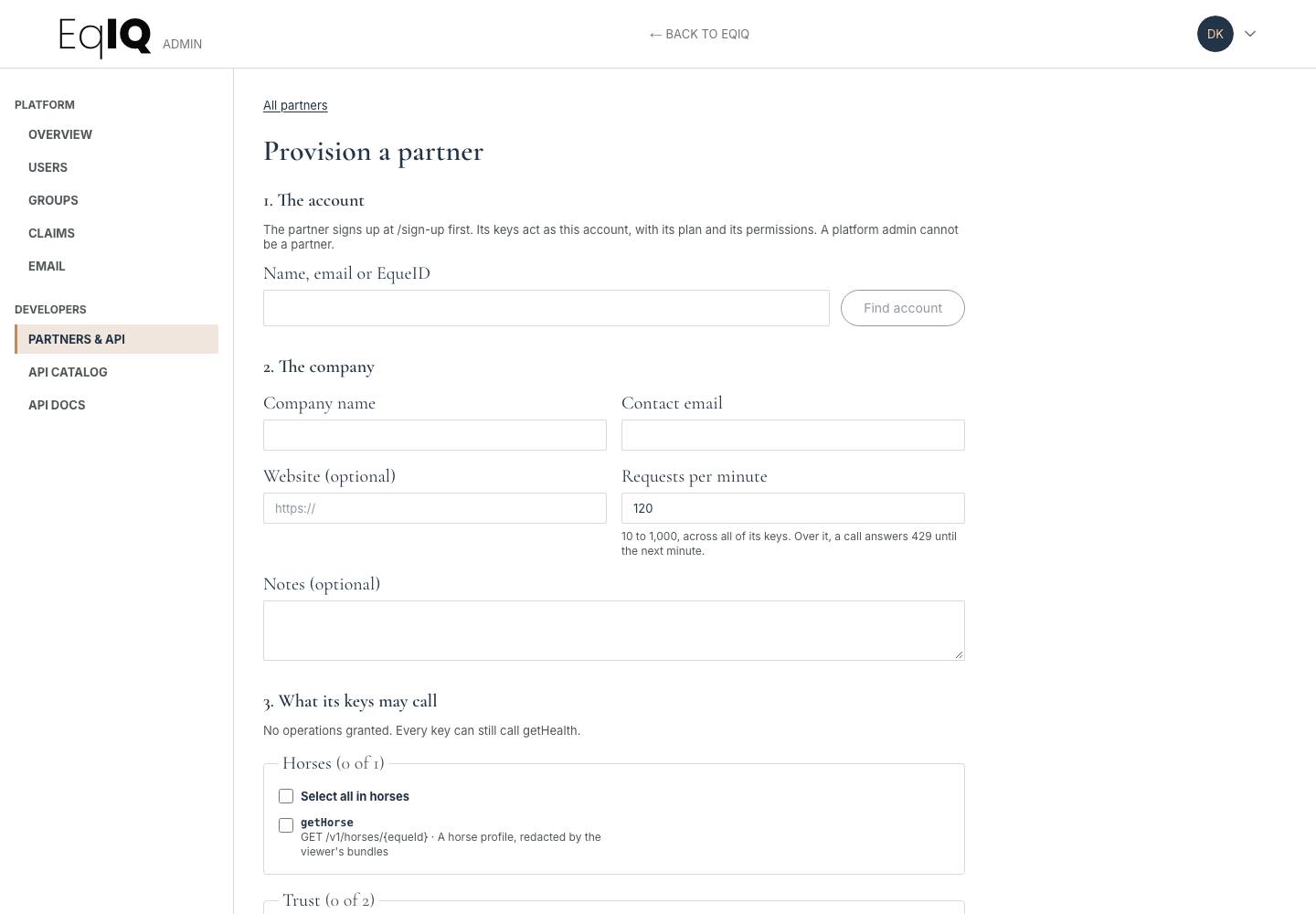
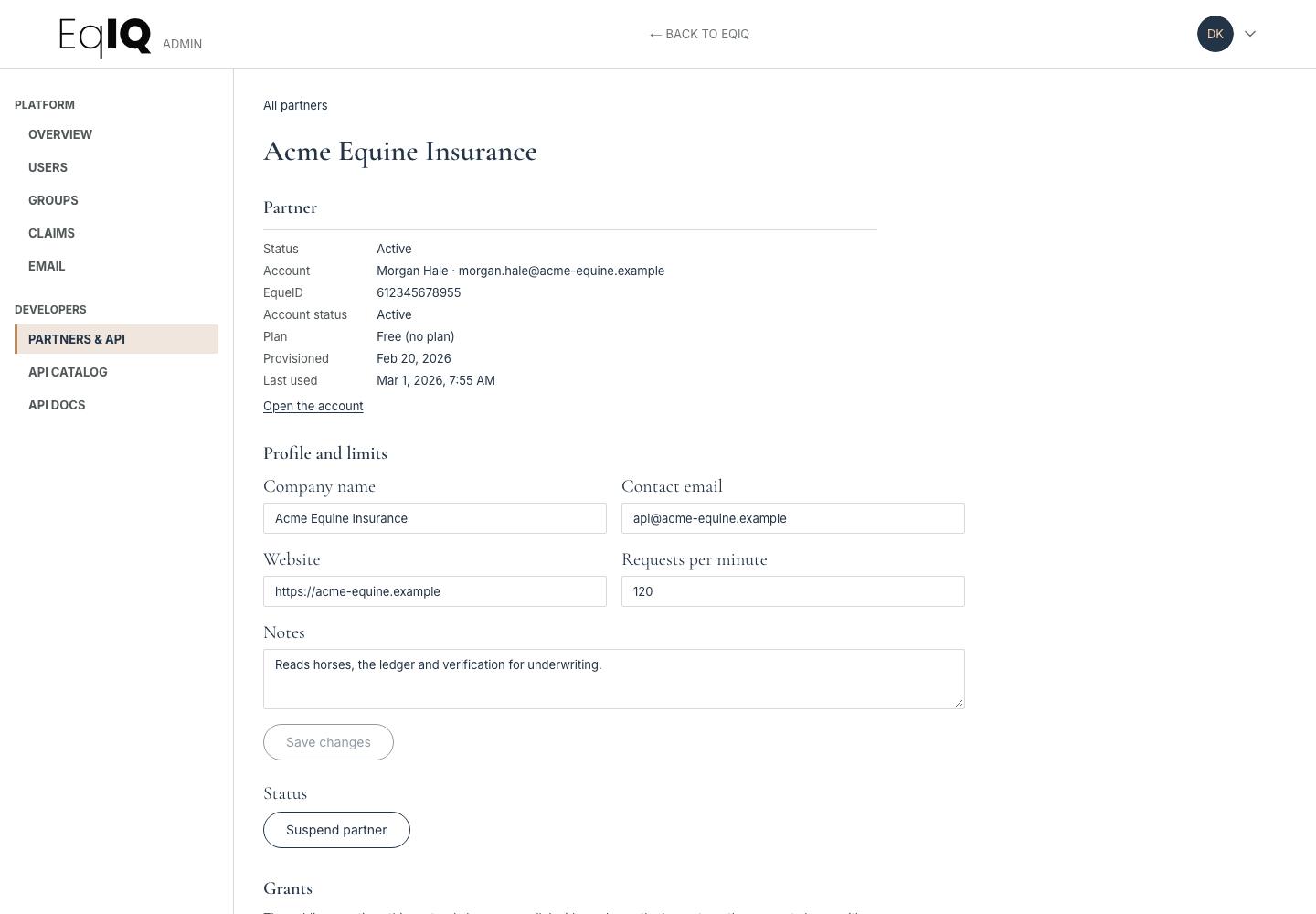
6. Partners and API keys
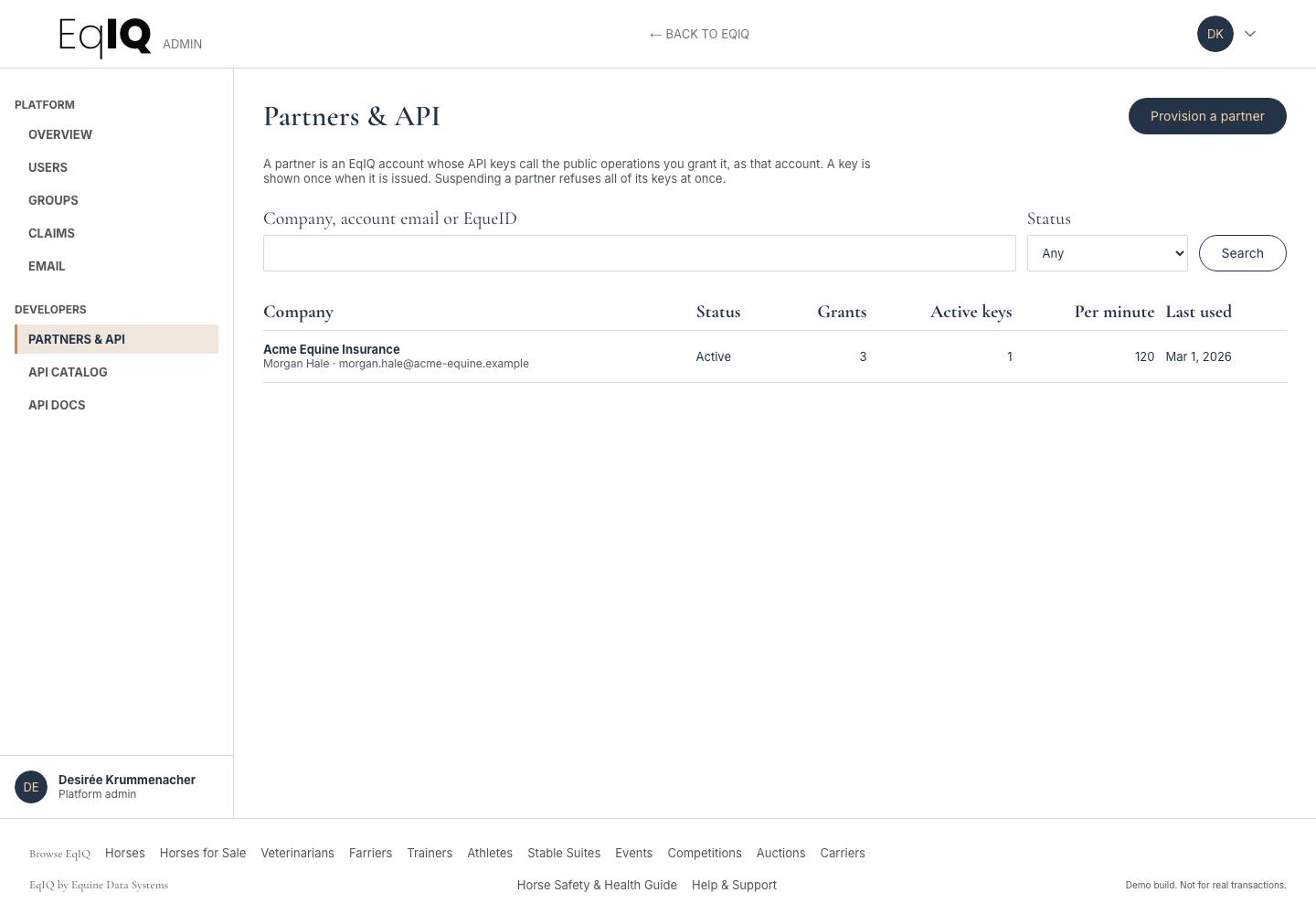
An insurer, a registry or a show office may want to plug into EqIQ's records. Now they can, under rules an admin sets.
- A key, shown once. An admin turns a member's account into a partner and issues a key. EqIQ keeps only a fingerprint of it, so even EqIQ cannot read it later.
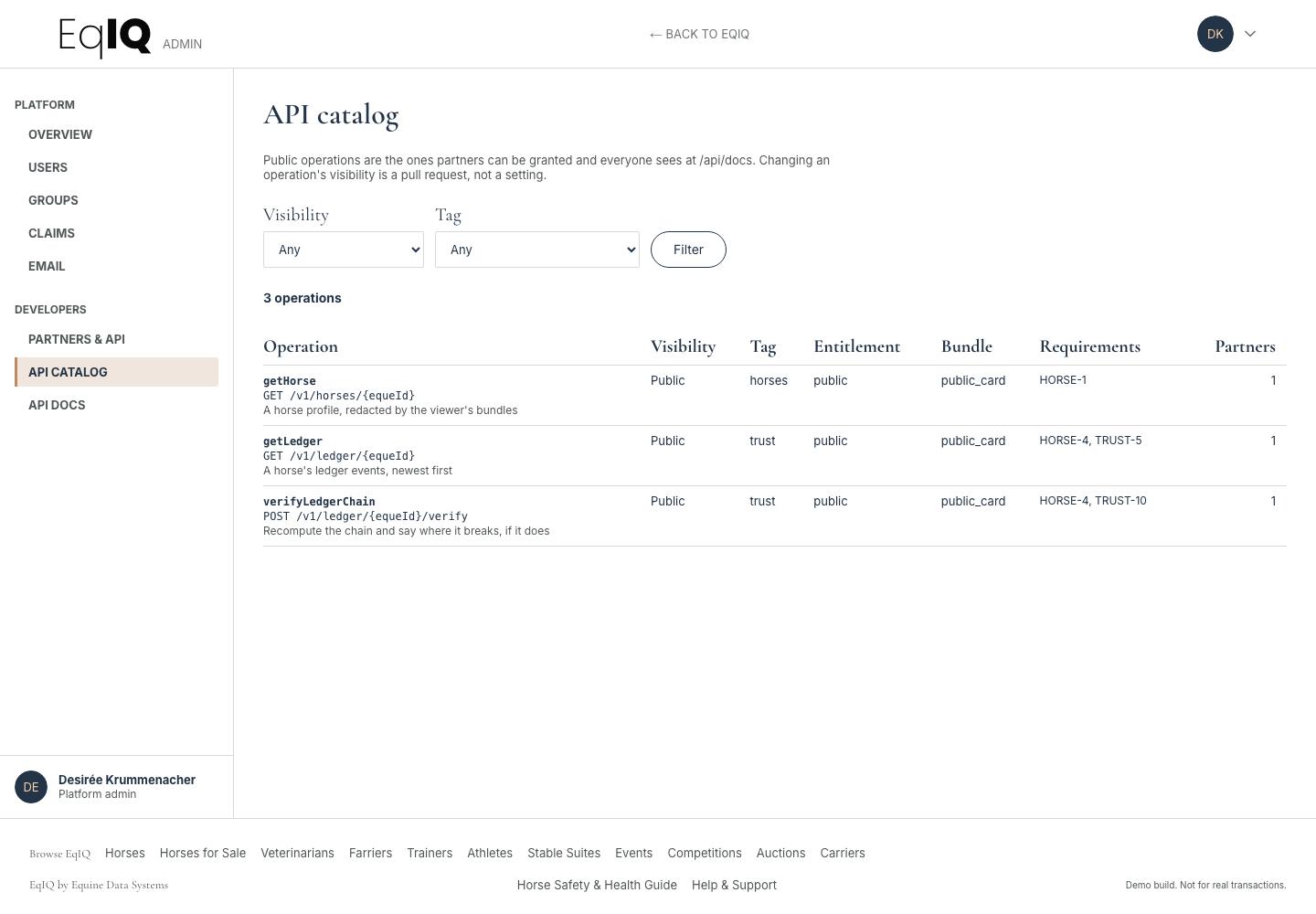
- Only what was granted. A key can call only the public operations an admin picked, and it sees only what its account is allowed to see. Of 295 operations in the rulebook, 52 are public.
- A speed limit and a log. 120 requests a minute unless the admin changes it. Every request is logged without its contents, and the log is cleared after 90 days.
- Easy to stop. A key can expire or be revoked, and a partner can be paused with one button.
7. Help, one click away
The "Chat with us" button sits in the corner of the screenshots above. It is live on every member page.
- AI first, then a person. Intercom's AI helper answers from approved help articles and hands the conversation to a person when it cannot help. The help articles are still being written.
- No weight until it is needed. The chat software loads only when someone clicks, so pages stay fast and nobody gets an extra cookie.
- Private by default. A signed-in adult gets a ten-minute pass so the team knows who is asking. Children and signed-out visitors chat without their identity being sent. Signing out closes the chat.
8. Checked before launch
Less visible work that keeps the product honest, fast and safe.
- All twelve stories, tested by robot. Each demo walk-through now runs by itself on a laptop screen and a phone screen. Writing those tests found bugs such as a breed search that missed a horse, auctions sorted by the wrong clock, and three places where a child's account skipped a safety check. All fixed.
- A full hand check. All twelve stories were walked again on the live demo, with 545 screenshots. It found 23 problems, one serious: a page too wide for a phone. 21 are fixed. Two remain: a slow checkout step and a missing screen for a young rider to ask to enter a class.
- Accessibility checks after every merge. About 65 screens per screen size are checked automatically for problems that would stop someone using a screen reader or a keyboard.
- A security review. Nothing critical found. Three privacy leaks and one missing set of browser safety rules were fixed. A critical flaw in the web framework was patched the same night it was announced, and a serious flaw in a build tool the next day.
- A speed pass. Pictures are 42 to 51 percent smaller, fonts and scripts are lighter, and the home page loads in 2.9 seconds on a simulated slow phone, down from 3.5. The goal is 2.5. A horse page already meets it at 2.45.
- Saves that stick. The hosting network was refusing saves that had already worked, so a visit could not be finished on the live site. It was fixed the same hour. An older edit can no longer overwrite a newer one, and admins keep their logins when the sample data is reloaded.
9. On a phone
A farrier works from a truck, and most people search from a phone. Every new page fits a phone screen.
47 more decisions, written down
Every time the plan was silent or two documents disagreed, someone picked an answer and wrote it in a log. The log now runs to decision number 200. These are the ones from this issue that made the biggest difference. The small codes point to the log entry.
Works better
- A real workspace for farriers, not just a sign-in. A second source of signed, trusted records. D-157
- Every record can be found, verified or not, by search engines and AI assistants. D-156
- Pages for places. "Equine Veterinarians in Paris, Texas," with a one-line fact summary and a share picture. D-166
- An address is forever. Old links keep working, and a name never passes to someone else. D-164
- Admins can write their own emails and send Announcements from news.eqiq.co. D-153, D-190
- Partners get keys to the public parts of the API, with limits. D-184
Faster
- Saved copies of public pages, refreshed the moment a record changes. Search traffic never touches the database. D-162
- Lighter pages. Smaller pictures and fonts, and the error-reporting script loads after the page. D-187
- Chat loads on the first click. No extra weight on any page until someone asks for help. D-159
- Member filters in under half a second, tested with 10,000 extra accounts. D-171
- Pictures checked by a second AI, in parallel. About 90 images a minute, with nothing paid twice when the provider paused. D-185
Safer for people
- Three privacy levels plus a search switch. For a child, only a parent holds the switch. D-163
- Every page follows the person's own choices, including owner boxes and care-team lists on other people's pages. D-186, D-176
- A parent can always see their own child's private page. Strangers cannot. D-196
- Private details go only to their owner in an email, and names come only through one locked door. D-170
- Role pages follow the settings too. A Semi-private vet page stays members-only. D-168
More secure
- Patch the main code first. A critical flaw and a high one were fixed within a day of being announced. D-174, D-199
- The demo cannot leak into search. Listing needs three things to be true at once, and the demo fails all three. D-165
- Test tools keep their key at home. The key goes only to EqIQ's own site, and it was replaced at the end of the run. D-191, D-197
- Partner keys are shown once and stored only as a fingerprint. D-184
- Chat identity is a ten-minute pass. When in doubt, the visitor is anonymous. D-159
More reliable
- Saves stop failing on the live site. The server now returns the version tag the hosting network checks for. D-160
- Nobody's change is silently overwritten. Edits compare versions, and the horse form warns "This horse changed since you opened it." D-172, D-173
- Admins are carried across data reloads. D-161
- The robot tests work again, after 18 failures nobody had noticed, and every page sits within four clicks of the home page. D-177
- A daily email budget with a reserve, so an announcement can never block a password reset. D-198
Nine days in figures
The code, the cost, and the time it would have taken
The same three questions as last issue, counted the same way. How much was built, what did the AI cost, and what would this have taken the old way?
Lines of code
Counted from the code repository this morning. Files that machines produce on their own, like the API schema file, and the sample-data files are listed separately and are not counted as lines of code.
Over the nine days, 82,723 lines were added and 5,191 were removed or rewritten, in 49 commits. About four in ten of the new lines are tests. The app now has 1,054 source files, 350 test files and 149 kinds of pages, up from 91.
AI credits
The build ran on Claude, through Claude Code, Anthropic's tool for coding with AI. Every message it exchanged is on record, so the count below is measured, not guessed. A "token" is about three-quarters of a word.
What that would cost at pay-as-you-go prices: about $3,500 across the models used. What was actually paid is much less, because the work runs on a Claude Max subscription, a flat $200 a month, topped up with extra usage credits when the allowance runs out.
What was actually paid, all in:
The bars show Claude usage by day at list prices. The two big days were Monday the 28th, when the farrier workspace, person pages and readable addresses went in, and Monday the 5th, when the robot tests, photographs, partner keys, security review, speed pass and emails went in. The Claude figures are measured from the session records and the account's usage page. The OpenAI figures come from the image pipeline's own spending log. Not included: the ordinary bills for hosting, email and the chat service.
The human equivalent
How long would this have taken a team of people? Nobody can know exactly, so here are the same three ways to estimate it as last issue.
1. Bundle by bundle. Each of the 49 merged bundles was sized the way an engineering manager would: a small fix at most of a day, a medium feature at two to three days, a large one at a week, the biggest at eight days, all including tests and review. Plans and records at half a day to a day and a half. Total: about 142 engineer-days, or 1,130 hours.
2. Line by line. 74,000 new lines of tested, reviewed code at a brisk professional pace of 200 to 400 finished lines a day is 186 to 372 engineer-days, or 1,490 to 2,980 hours.
3. Team and calendar. The plans' own estimates were three to four weeks for two engineers for the farrier workspace and 52 to 70 engineer-days for search. Add person pages, emails, partner keys, the chat, the robot tests, the security and speed work and the photographs, and a four-person team would need about 10 to 14 weeks, or 1,600 to 2,240 hours.
One to three thousand engineer-hours of work, done in nine days.
At a typical loaded rate of $120 an hour, that is $135,000 to $360,000 of engineering. It was bought for about $500 of AI, all in, plus about 5½ hours of Karl's time: 28 instructions and decisions typed into Claude Code in 16 short sittings. That time is measured from the session records. The same method gives 25 hours for Issue 1, close to Karl's own count of 26. That is hundreds of times cheaper than the human way.
How the work was organized. The same machine as last issue, with three new habits. Each run now starts with Karl's ordered list and spending limits. Watchdog sessions take over when a session stalls or hits a usage limit, and each run's lessons are written into the playbook. And every demo story is now a robot test, so a change that breaks a story is caught the same day.
What is left in the plan
Of the 116 must-have requirements, 114 now have a test that proves them. Here is what is still open, in order.
Next up
- The last two must-haves. An admin page to choose and test the outside services (payments, the chain anchor, email), and one page for the logs.
- A faster checkout step. "Confirm and pay" takes about 4 seconds on a laptop and 5 on a phone.
- A screen for young riders to ask a parent to enter a class. Today the demo uses a sample request.
- Home page speed: 2.9 seconds today, 2.5 is the goal.
- Tidying up: 15 photos to redo, some older profile text, and dates that show the next day in the evening.
Queued and planned
- Help articles for the support chat to answer from.
- Farrier extras: hoof photos, an email when a shoeing is due, and real voice-to-text.
- More email: scheduled sends, and the rest of the fifty planned emails, each with its feature.
- Testers get real accounts, with sign-in codes by email, and the spreadsheet import learns to fetch photos from links.
- The launch checklist for search: real members on eqiq.co first, then one switch.
Later
- Real payments. The demo mocks every card and bank step behind an interface, so a real provider drops in.
- A real blockchain anchor. The chain is real; the anchor is simulated. The slot for it is built.
- Privacy, security and SOC 2 work, before the first real user.
- The public eqiq.co page with a waitlist, real photography and house ads.
- Native phone apps, and connections to registries and microchip databases.
Good to know before you share this
- The demo is private and hidden from search engines by design. To look around, ask Karl for an invitation.
- No real money, card numbers or bank details exist anywhere in the system. Payments and the blockchain anchor are simulated.
- Every horse, person, stable and event is sample data. The new photographs, logos and "About Me" texts were made by AI for the demo. Ad artwork is shown as drawn in the design file and does not mean a sponsorship. A few association pages and two sample pedigrees use real names as reference data.
- The support chat is live, but its help articles are still being written.
- This issue replaces the first version of Issue 2, sent on October 5. It now runs through the morning of October 6 and adds what that version left out.
- A correction: Issue 1 first went out with each date labeled one weekday early (September 20, 2026 was a Sunday). It has been fixed.